

Agility Course for Dogs
Training for Small Dogs and Toy Poodles
Safety in dog sport training.
The Toy Poodle is a small, agile, brave dog with a strong desire to please its owner. And that is exactly why extra care is needed. Often, the issue is not that the dog doesn’t want to perform an exercise. On the contrary — it is eager, motivated, and throws itself into the task with enthusiasm. But motivation is one thing, and physical readiness is another.
With such small dogs, safety must always come before performance.
Don’t start too early.
Sport training should not begin too soon. Before introducing more demanding physical exercises, it is important to wait until the puppy has fully developed. In a Toy Poodle, serious sport training should not start before one year of age. Until then, bones, joints, ligaments, and the entire body structure are still maturing.
A young dog may seem agile and willing, but that doesn’t mean its body is ready to handle impact, jumps, climbs, or repeated strain.
Enthusiasm can also be a risk.
A Toy Poodle will often not hold itself back. If encouraged, it will try to perform even without sufficient strength, balance, or maturity. This means: it may jump higher than it should, it may come down too fast, it may force positions it is not ready for, it may suffer a bad fall simply because it wants to do well. That’s why the responsibility always lies with the human.
Height and size of obstacles matter.
With high obstacles such as: dog walk, ramp, seesaw, A-frame, it’s important to understand that not all equipment is suitable for a Toy Poodle. Obstacles designed for larger dogs may be excessive for such a small breed. If the dog slips, loses balance, or falls from too high, the risk of injury increases significantly. Equipment must be adapted to the dog’s size. Height, width, and stability all need to be appropriate for a small dog.
Safety first, then technique.
Before asking for speed, precision, or long sequences, the dog must feel: safe, balanced, confident, physically prepared.
There is no rush. For a Toy Poodle, building a healthy foundation is far more important than progressing quickly.
What you should avoid.
Starting high jumps too early, using equipment designed for medium or large dogs, training on slippery surfaces, doing too many repetitions in a row, allowing uncontrolled descents from ramps or dog walks, training when the dog is tired, confusing enthusiasm with physical readiness.
What you should do.
Wait until the dog is mature enough, start with low, stable, safe exercises, use equipment adapted for small dogs, always monitor how the dog lands and descends, keep sessions short, stop before the dog becomes fatigued. Always prioritize health over performance.
Key idea: A Toy Poodle can be very brave, energetic, intelligent, and eager to work with you. But precisely because it trusts you and wants to do well, it’s your job to set the limits. It’s not about seeing how far the dog can go — it’s about protecting its body so it can enjoy training for many years.


Agility
Agility is one of the most complete dog sports. It involves guiding the dog through an obstacle course, combining speed, precision, and communication. Why is it ideal for the Toy Poodle? The Toy Poodle: is fast, highly intelligent, loves working together with its owner. That’s why agility is a perfect fit for this breed.
Agility obstacles can be divided into three simple groups.
Jumping obstacles must be cleared without knocking anything down.
Contact obstacles require the dog not only to cross them, but also to touch the marked contact zones at the beginning and the end. At some modern competitions these zones are already monitored by electronic sensors, and arguing with them is about as useful as arguing with a bathroom scale.
Finally, there are skill and speed obstacles, such as tunnels and weave poles, where jumping ability matters less than knowing exactly where to go. In the end, agility tests not only the dog's athletic ability, but also how well it understands its handler.
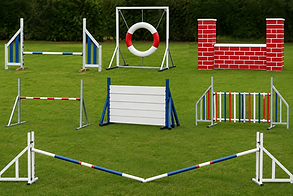
1. Jumping obstacles agility
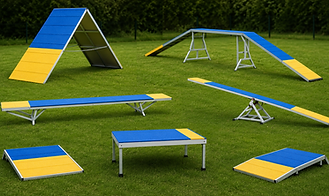
2. Contact obstacles agility

3. Skill and speed obstacles
Agility Levels: Competition Classes and Jump Heights.
The higher the agility level, the less it resembles a walk in the park. The jumps become higher, but what really changes is the course itself: tighter combinations, sharper turns, tricky changes of direction, and obstacles that seem determined to send the dog the wrong way. At beginner level, small mistakes may still be forgiven. At the highest levels, however, victory goes not to the fastest runner, but to the fastest thinker. Sometimes one look at the course map is enough to suspect that the judge spent the previous evening solving mazes.
There are three competition levels in agility: Class 1, Class 2 and Class 3. Every dog starts in Class 1. Moving up takes more than simply entering competitions—you must complete several courses with very few, or no, faults under different judges. Once enough perfect runs have been achieved, promotion is no longer optional; it becomes mandatory. Going back to an easier class to collect trophies against beginners is not allowed. It's a bit like school: you can move up to the next grade, but you can't officially ask to go back to the first one.
And here is some good news for Toy Poodle owners. The height of most jumping obstacles depends on the dog's size. That means our little athletes do not have to clear the same heights as a Border Collie or a German Shepherd. Toy Poodles jump the lowest heights, but the demands for speed, precision and teamwork remain exactly the same.
Jump Heights in Agility
Category Dog's height at the withers Jump height*
S (Mini) under 35 cm 25–30 cm
M (Medium) 35–43 cm 35–40 cm
I (Intermediate) 43–48 cm 45–50 cm
L (Large) 48 cm and over 55–60 cm
* The exact jump height within the permitted range is chosen by the judge. In Class 1, the minimum permitted height is usually used.
Agility Competition Classes
Class What does it mean?
Class 1 The entry level. Every team begins here. Courses are slightly easier, and jump heights are usually set to the minimum permitted level.
Class 2 The next level. Dogs reach this class after consistently achieving good results in Class 1.
Class 3 The highest level. This is where the most experienced teams compete, and where official titles and championship certificates are awarded.
In agility, nobody can enter Class 3 right away—you have to earn your place through good results. Once a team has completed the course perfectly several times, the rules say it's time to move up. Going back to a lower class is not allowed. After all, nobody expects the top student to go back and take the first-grade exam again.
How Is the Winner Decided in an Agility Competition?
The fastest dog does not always win. First, the penalty points are compared: the fewer, the better. If two teams have the same number of penalties, the team with the faster time wins. That is why it is sometimes better to lose one second by taking an obstacle carefully than to lose five penalty points for knocking down a bar. Speed matters in agility, but only when it gets along with accuracy. It is better to finish first without faults than to look spectacular while heading in the wrong direction.
How Do You Teach a Dog to Jump a Hurdle?
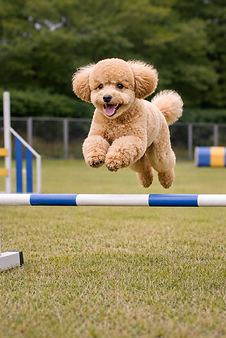
The jump is one of the most basic agility exercises. The dog must clear a bar without touching it while maintaining rhythm and control.
Goal. The dog should: jump over the obstacle, avoid knocking down the bar, keep a steady rhythm and perform confidently.
How to teach it step by step.
-
Start with the bar very low, almost on the ground.
-
Walk over it first. Before asking for a jump, let the dog simply step over the bar without pressure.
-
Guide with your hand. Use a treat and move your hand forward. The dog will follow and go over the obstacle.
-
Mark and reward. When the dog steps over or jumps: "Good!" and reward immediately.
-
Repeat several times to build confidence.
-
Raise the height gradually, little by little.
-
Add the cue "jump." Recommended cue: "jump." Hand signal: move your hand forward. Practice in short sessions with few repetitions, always using positive reinforcement.
⚠️ Common mistakes: Raising the bar too quickly → fear or mistakes. Forcing the jump → refusal. Progressing too fast → poor technique. Too many repetitions → fatigue.
Key tip: Good technique is more important than height.

How Do You Teach a Dog to Weave Through the Poles?
The weave poles are one of the most difficult agility obstacles.
To us, they look like a simple zigzag, but your dog has to enter from the correct side,
move like a furry little snake, and still keep an eye on you.
At first, many dogs decide to "improve the course" by skipping a few poles because, in their opinion, that's obviously faster.
Goal. Your dog should: enter the weave poles correctly; weave through every pole without skipping any;
keep a steady rhythm; stay focused on your guidance.

How to teach it step by step.
1. Place the objects. You can use bottles, cones, or chairs. Place them in a straight line, leave plenty of space between them at first.
2. Start slowly. Place the dog at the beginning of the course.
3. Guide with your hand. Using a treat: move your hand in a zigzag pattern, between the objects. The dog will follow you.
4. Mark and reward. At the end of the course: say “Good!” and give a reward.
5. Repeat several times. This helps the dog understand the pattern.
6. Reduce the distance. Little by little: move the objects closer together, ask for more precision.
7. Add the cue. Once the dog does it well, add the cue: “slalom” / “zigzag”. Recommended signal: Word: “slalom”. Gesture: guide with your hand in a zigzag motion. How long to practise: Keep sessions short, movements slow, and don’t rush.
⚠️ Common mistakes: Starting with objects too close together → confusion.
Going too fast → the dog loses the pattern. Forcing the movement → resistance.
Repeating too much→ fatigue. Key tip. Precision first, speed later.
How Do You Teach a Dog to Run Through a Tunnel?
The tunnel is one of the most dynamic agility obstacles.
The dog must enter, go through it, and exit without losing direction or confidence.
Objective. The dog should: enter without fear, go through the tunnel, exit with confidence,
maintain direction.
How to teach it step by step.
1. Start with a short tunnel. Use a straight tunnel, as short as possible.
2. Make the exit visible. The dog should be able to see both the entrance and the exit.
3. Motivate from the other side. You can: call the dog, show a treat or use a toy.
4. Mark and reward. When the dog comes out: say “Good!” and give a reward.
5. Repeat several times. This helps build confidence.
6. Increase the difficulty. Little by little: use a longer tunnel, add a slight curve, add a little more speed. Add the cue, “tunnel” / “go in”. Recommended signal: Word: “tunnel”. Gesture: point your hand toward the entrance. How long to practise: Keep sessions short, positive, and pressure-free. ⚠️ Common mistakes: Starting with a long tunnel → fear. Forcing the dog to enter → resistance. Not showing the exit → insecurity. Repeating too much → overload.
Key tip: Confidence is the key, not speed.
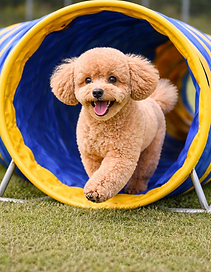
Modern agility competitions use only one type of tunnel: the rigid open tunnel. That doesn't stop course designers from getting creative. The easiest version is straight, where the dog can see the exit from the entrance. Then come gentle curves, where the exit disappears from view. Finally there are S-shaped and U-shaped tunnels, where the dog has to trust the handler and keep going without knowing what's ahead. The judging is simple: enter correctly, exit correctly and don't miss the obstacle. The stopwatch takes care of everything else.
And honestly, you've got nothing to complain about. We still remember the days of the collapsed tunnel, where the rigid entrance was followed by a long fabric chute. Dogs charged in happily and, a second later, felt as if someone had thrown a blanket over them and wished them good luck. In the last video you can watch a Toy Poodle tackling this genuine agility relic.
How Do You Teach a Dog to Climb the A-Frame? This exercise teaches the dog to go up and down an A-frame while maintaining balance, control and confidence. It is one of the classic agility obstacles and is excellent for developing coordination. Goal. The dog should: climb without fear, reach the top, descend under control and keep its balance.
How to teach it step by step.
1. Start with a gentle incline. Before using a real A-frame, use an inclined board with a slight angle.
2. Guide with your hand. Hold a treat in front of the dog. The dog will follow your hand as it climbs.
3. Mark and reward. At the top or after coming down: "Good!" and reward immediately.
4. Repeat several times to build confidence.
5. Increase the incline gradually. Raise the height and angle little by little without rushing.
6. Add the cue "A-frame" or "up". Recommended cue: "up" or "A-frame." Hand signal: move your hand upward and then downward. Practice in short, relaxed sessions without pressure.
⚠️ Common mistakes: Starting with too steep an incline → fear. Descending too fast → loss of control. Forcing the dog → refusal. Slippery surface → insecurity.
Key tip: A controlled descent is more important than the climb.

How Do You Teach a Dog to Cross the Dog Walk?
The dog walk is an agility obstacle where the dog must walk up, across and down while maintaining balance and control.
Goal. The dog should: go up without fear, walk straight, keep its balance and come down in a controlled manner.
How to teach it step by step.
1. Start at a low level. Before using a real dog walk, use a board, a low platform or any stable surface.
2. Guide with your hand. Hold a treat in front of the dog. The dog will follow your hand and move across the surface.
3. Mark and reward. When the dog crosses: "Good!" and reward immediately.
4. Repeat several times. This builds confidence.
5. Increase the height gradually. Start very low and raise it little by little.
6. Add the cue "dog walk" or "up". Recommended cue: "dog walk." Hand signal: guide your hand forward. Practice in short, positive sessions without rushing.
⚠️ Common mistakes: Starting too high → fear. Forcing the dog → refusal.
Using an unstable surface → loss of confidence. Moving too fast → loss of balance.
Key tip: Confidence comes first, height comes later.
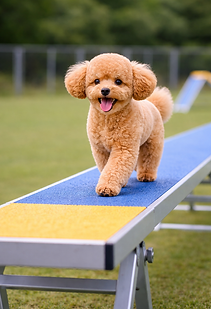
How Do You Teach a Dog to Use the Seesaw?
Don't put your dog straight onto a full competition seesaw. For most beginners,
a moving plank looks like a terrible idea. First, your dog should confidently walk across
a narrow, stable board, then a slightly moving surface, and only after that be introduced
to the real seesaw. Take your time, praise every confident step,
and never let the board slam onto the ground while the dog is on it.
In competitions, the seesaw is usually adjusted so that it starts tipping even
under the weight of a very small dog—around one kilogram.
Training equipment, especially outdoors, is a different story.
It may not have been adjusted or maintained for a long time.
If the pivot is rusty or poorly adjusted, the board may not tip until the dog is almost at the end. It then drops with a loud bang and can frighten the dog enough to create a lasting
fear of the obstacle.
Before every training session, check the seesaw. If it moves stiffly, clean and lubricate the mechanism. Then place a sandbag weighing about the same as your dog on the board. If it begins to tip smoothly without a hard impact, you're ready to train. Ideally, your dog should think, "Oh, that's easy," not, "I think this board has declared war on me."
The hardest part of the seesaw is often not the seesaw itself. The real challenge is teaching the dog not to jump off too early. Trying to avoid the board hitting the ground, many dogs leap off before the seesaw has completely tipped down. As a result, they miss the contact zone and receive a penalty.

Crossing Water on the Course
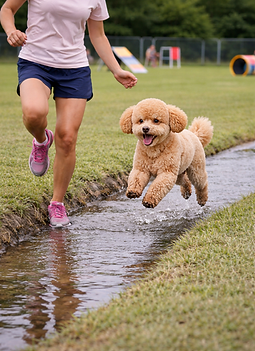
Although agility does not include a water obstacle, competitions are often held outdoors, and after rain there may be puddles on the course. Dogs that are used to running only on dry ground sometimes stop, hesitate, or try to go around them, losing both time and focus. It's much better to introduce your dog to this situation during training so that water is never an unexpected surprise on competition day.
Goal. Your dog should: confidently run through puddles or shallow water; avoid trying to go around them;
keep a steady rhythm and confidence; stay focused on your guidance instead of the water.
How to teach it step by step.
1. Start with a small amount of water: a puddle, a tray of water or a wet surface.
2. Let the dog explore. Never force it.
3. Encourage the dog to cross. Use a treat, a toy or call the dog through the water.
4. Mark and reward. When the dog crosses: "Good!" and reward immediately.
5. Repeat several times to build confidence.
6. Increase the difficulty gradually. More water, a wider area and slightly greater depth (very gradually).
7. Add the cue "water" or "cross". Recommended cue: "water." Hand signal: point forward. Practice in short, positive sessions without forcing the dog.
⚠️ Common mistakes: Forcing the dog into the water → fear. Starting with water that is too deep → refusal. Cold or uncomfortable water → negative experience. Too many repetitions → overload.
Key tip: Confidence is more important than the exercise itself.
How Do You Prepare a Dog for Its First Competition?
For a dog, the first competition is like the first day of school: unfamiliar people, dogs everywhere, loudspeakers, applause, and an atmosphere completely different from training. If your dog has never experienced anything like it, don't be surprised if it's more interested in watching the world than listening to you.
The best preparation isn't doing more obstacles. It's getting your dog used to everything that surrounds a competition. Visit busy places, let your dog watch other teams, teach it to wait calmly for its turn, and then focus when it's time to run. On your first competition, don't worry about winning. If your dog leaves the course happy and eager to do it again, you've already achieved the most important victory.
How Do You Improve Speed in Agility?
Everyone wants their dog to run faster. The dog usually agrees. The problem is that running like a rocket doesn't help much if your dog skips half the obstacles or decides to invent its own course.
Real speed comes when your dog understands the course, trusts your guidance, and takes turns without hesitation. A clean run is almost always faster than one full of braking, mistakes, and extra loops.
Before asking for more speed, make sure your dog knows exactly where it's going.
How Do You Improve Accuracy on the Course?
Accuracy doesn't mean your dog has to run slower. It means your dog should stop inventing creative shortcuts. One jump here, one tunnel there... from your dog's point of view, it's still a perfectly good course.
The better your dog understands your signals, the fewer mistakes it will make. In agility, just a few centimetres can be the difference between a perfect run and "We almost had it!"
How Do You Train Obedience for Agility?
In agility, obedience isn't about your dog sitting nicely when asked. It's about remembering you still exist while running at full speed.
A dog that listens to your signals can change direction in a split second, take the correct obstacle, and avoid many mistakes. In agility, obedience doesn't make the run more boring... it makes it much faster.
What Mistakes Do Beginners Make in Agility and How Can You Fix Them Early?
The most expensive mistake in agility isn't knocking down a bar. It's moving on too soon. Many beginners want to teach the next obstacle before the previous one has been fully mastered. It looks like the dog is making amazing progress... until the problems begin.
Take jumps as an example. If your dog charges towards the jump like a rocket but doesn't know where to take off, more and more bars will start falling. A simple exercise solves this: place a pole on the ground just before the jump, close enough that the dog cannot take another step between the pole and the obstacle. The pole naturally marks the take-off point and teaches the correct jumping technique. Spending two extra weeks on this exercise is far easier than spending months fixing bad habits—or dealing with an injury caused by hitting a bar at full speed.
The same applies to contact obstacles. Don't increase the difficulty until your dog confidently touches the contact zone every single time. If it learns to skip it in the beginning, correcting that habit later will take far more time and effort than spending a couple of extra weeks polishing the basics.
Another common mistake is ignoring the condition of the equipment. Every climbing and descending surface should provide good grip and be free from cracks, splinters, or damage. An injury may heal, but fear often stays much longer.
A friend of ours, María, trained on a public agility field where enthusiasts had built wooden obstacles themselves. Over the years the wood dried out and cracked. One day, while running down the dog walk, her dog's nail caught in one of those cracks. The nail broke and the dog injured a toe. The physical injury healed, but it took almost six months before the dog trusted the dog walk again. Even today, it still tries to jump off early because it remembers that something there once hurt its paw.
Perhaps the most important advice of all: don't train to finish the course—train to perform each obstacle correctly. Speed comes naturally. Precision follows. Bad habits, however, always take much longer to unlearn than good habits take to build.
What Equipment Do You Need to Practise Agility?
Ask a dog, and the essential equipment for agility consists of three things: running, running… and then running a little more.
But the best way to begin is to find an agility club nearby. There you will have a course with safe obstacles, an instructor who can help you avoid many beginner mistakes, and almost certainly some new friends who enjoy talking about dogs just as much as you do.
You do not need to buy half an agility course to practise a few exercises at home. Some cones, a couple of adjustable poles, and enough space may be all you need. The full set of equipment can wait. First, you need to learn how to use it correctly.
Which Agility Books Are Worth Reading?
For many years, the vast majority of the best books on dog agility have been published in English. If you can read English, you have access to the ideas and training methods developed by some of the world's most influential agility instructors.
Of course, no book can replace an experienced coach or regular practice on the training field. However, good books help you understand why certain exercises work, avoid common beginner mistakes and build a solid training system instead of relying on random tips from the Internet.
Agility Right from the Start — Eva Bertilsson & Emelie Johnson Vegh (2006, 2nd edition 2017).
This is considered by many trainers to be one of the best foundation books ever written. Rather than teaching obstacles immediately, it focuses on motivation, self-control, teamwork, toy value, reward placement and all the skills a dog should learn before running a full course. If you only buy one agility book, this would probably be the best choice.
Foundation Fundamentals — Susan Garrett (2009).
Susan Garrett is one of the world's best-known agility competitors and instructors. Her methods have influenced thousands of trainers around the globe.
This book explains how to develop focus, impulse control, recalls, commitment and independence before introducing difficult sequences. Much of modern agility training is based on these concepts.
Developing Handling Skills — Linda Mecklenburg (2010).
Linda Mecklenburg is famous for developing modern handling systems based on the dog's line and biomechanics.
Unlike many books that concentrate mainly on obstacle training, this one teaches the handler how to communicate clearly through body language, timing and movement. It is especially useful once both dog and handler know the basic obstacles.
Agility Bible — Julie Daniels (1998).
Although some handling techniques have evolved since its publication, this remains one of the classic books on agility.
It covers obstacle training, motivation, course work, competition preparation and solving common training problems. Many experienced competitors still recommend it as an excellent introduction.
Agility Training — Jane Simmons-Moake (2006).
A practical guide for beginners that explains each obstacle step by step, introduces basic handling techniques and includes many simple exercises that can be practised during regular training sessions.
Successful Agility Handling — Ruth Hobday (2012).
This book focuses almost entirely on the human side of agility. It explains positioning, timing, front crosses, rear crosses, blind crosses and how to guide the dog efficiently around a course.
A great choice for handlers who already understand the basics but want smoother, faster runs.
Clean Run Magazine Collection.
Although not a single book, Clean Run has published hundreds of articles written by the world's leading agility competitors and coaches.
Many modern training ideas first appeared in its pages before becoming widely adopted. If you enjoy studying different training systems, the magazine archives are an outstanding resource.
Better Agility Through Science — Stewart Hilliard (2019).
One of the newer books on agility, written from a scientific perspective.
Instead of relying only on experience, it explains how learning theory, biomechanics, conditioning and modern sports science can improve performance while reducing the risk of injury.
Canine Sports Medicine and Rehabilitation — Millis & Levine (2nd edition, 2014).
This is not strictly an agility book, but many top competitors consider it essential reading.
It explains canine anatomy, conditioning, injury prevention, warm-up routines and rehabilitation. For anyone serious about agility, keeping the dog healthy is just as important as teaching new skills. If you had to choose only three books, they would probably be: Agility Right from the Start — the best foundations. Foundation Fundamentals — building a motivated, confident partner.
Developing Handling Skills — learning how to communicate effectively on the course.
Today, however, many of the best agility lessons are no longer found only in books. Online courses, seminars and training videos from leading international competitors have become an equally valuable source of knowledge. Watching experienced handlers work with their dogs often teaches as much as reading an excellent book.