

Toy Poodles seem like the kind of breed that requires a personal stylist, three assistants, and a beauty schedule busier than their owner's.
Fortunately, the reality is much simpler. 😄
Yes, they do require some care that other breeds can afford to ignore. But most of it is easy to do and takes only a few minutes once it becomes part of the regular routine.
Here you will find information about grooming, health, nutrition, preventive care, and many other important topics to help your Toy Poodle stay healthy, comfortable, and happy throughout its life.
Before we go into the details,
we have prepared a video guide
covering the basics of Toy Poodle care.
If you would prefer to start with a general overview
and then explore each topic in more depth,
we recommend watching it first. 🐩
Next, we will look at the two main areas
that every owner should understand:
daily care and Toy Poodle health.
Toy Poodle Care & Health


🧠 Toy Poodle coat: why it’s different
The Toy Poodle’s coat is not like that of other breeds. It is completely different. It does not shed like other dogs: dead hair does not fall to the ground, but remains trapped within the coat itself.
This has a big advantage — you won’t find hair on your clothes or sofa — but it also has an important consequence:
if it is not brushed, tangles (mats) will form.

In addition, its structure is unique.
• 👉 More than 80% is undercoat. 👉 Less than 20% is guard hair (primary coat).
Only one group of dogs has something similar:
water dogs, with an approximate ratio of 70/30.
In most breeds (even small and “fluffy” ones), the ratio is usually 50/50
or less. That’s why the Poodle is so soft… but also more demanding.
If we look at the coat under a microscope,
its structure is much more similar
to human hair than to the coat of other breeds
such as the German Shepherd.
This explains why many people with allergies
tolerate the Poodle better.
⚠️ Important: The Poodle usually does not trigger allergies
because of its coat, but if the allergy is related to saliva, it will
still be present. And this applies not only to Poodles,
but to all breeds that are said to be “hypoallergenic.”
📊 Curious fact:
Do you know how many hairs there are per square centimeter?
Human: approximately 200–400. Toy Poodle: between 700 and 1000 (depending on the area of the body)!
In addition, breeders have spent more than 200 years selecting this breed to be smaller… and denser in coat.
👉 Do you really think it can maintain that coat on its own? The answer is clear: no.

✂️ How to care for a Toy Poodle’s coat
A Poodle’s coat grows continuously all over the body. If it is not properly maintained:
• Hair accumulates in the ears → risk of infections. • Hair grows on the paw pads → difficulty walking. • In the rear area → dirt can build up and cause problems. To keep a Poodle’s coat in perfect condition, there are several key aspects:
👉 Bathing a Toy Poodle. Brushing and detangling. Proper grooming products. Grooming tools
Accessories and clothing for a Toy Poodle


A detail many people don’t expect
The Toy Poodle is extremely clean. It doesn’t like being dirty or smelling bad.
Even in a show coat, it avoids getting dirty — it adapts, moves carefully, and does whatever is necessary.
And another curious difference: while other breeds may start to smell shortly after a bath, the Poodle keeps the scent of shampoo for weeks.
This is not a coincidence. It’s part of its coat type.
Small details that complete your dog’s well-being
Coat care is the foundation — and you already know how important it is for a Toy Poodle.
But for your dog to be truly well cared for, there are small details that are part of its daily well-being. These are simple routines, quick and easy to integrate:
👉 keeping the eyes clean and free from irritation, checking and cleaning the ears regularly, maintaining dental hygiene —
and trimming the nails when necessary.
They don’t take much time, but they help prevent problems and keep your poodle comfortable every day. Because good care is not only visible… it’s also reflected in how the dog lives and feels.


Toy Poodle Health
We've already talked about how to care for a Toy Poodle on the outside.
Now it's time to talk about how to care for one on the inside. ❤️
A beautiful coat may attract attention, but it is health, nutrition, prevention, and good habits that will truly stay with your dog throughout its life.
💉 Vaccination
Daily care is important, but it does not replace real protection against diseases. 👉 Vaccinations are not optional!
They protect your Toy Poodle from serious illnesses, and some of them… 👉 can be fatal.
💡 A dog can be clean, well fed, and well cared for… and still become seriously ill if it is not properly vaccinated.
That’s why vaccination is not an extra — 👉 it is a basic part of proper care.
👉 To learn which vaccines your Toy Poodle needs, when they should be given, and how to do it correctly:

🐜 Deworming & Parasite Protection
There are things you cannot see… but that can seriously affect your dog. 👉 Parasites are one of them.
Fleas, ticks, and internal parasites are not always noticeable at first, but they can cause important health problems. 💡 And in some cases, even serious ones.
👉 Here is a key point: A dog can be clean, well cared for, and appear perfectly healthy… 👉 and still have parasites.
⚠️ Especially important: Some parasites transmit dangerous diseases 👉 and they do not always show clear signs in the beginning.
In this guide, you will see which parasites can affect your dog and why they should never be underestimated (including real videos 🎥):

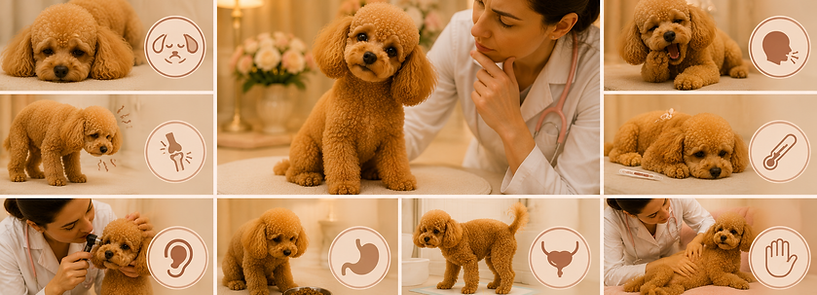
🔍 How to Tell if Something Is Wrong
A well cared for and properly vaccinated Toy Poodle is much less likely to become ill. But even then… 👉 things can still happen.
And here’s something important: your dog cannot tell you what hurts. 💡 But it can show you. Through small changes:
👉 in behavior, 👉 in appetite, 👉 in the way it moves, 👉 even in something as simple as stool or urine.
👉 Knowing what to look for can help you detect a problem early and also explain the situation better to your veterinarian.
👉 To understand which signs to watch for and how to interpret them:
Emotional Well-Being
A Toy Poodle does not only need physical care… it also needs mental stimulation
and attention. This is a very intelligent, sensitive, and people-oriented breed.
And here is something important: A poodle does not become depressed “for no reason.” In many cases, it is simply a lack of stimulation. An intelligent dog needs something to do. If it does not have: activity, interaction, small challenges, and especially if it spends many hours alone at home, 👉 it starts to become bored. And that boredom can turn into: apathy, nervousness, and unusual behaviors.
🎥 Here you can watch a video about depression in dogs:
The key: A busy poodle is a happy poodle. It does not have to be complicated: games,
small exercises, daily learning👉 To understand how to stimulate your dog properly
and teach it in a simple way:
