
How Does a Dog Think?
Spoiler: Not like you do.
1. Your dog is not planning to take over the living room.
Many owners believe their dog wakes up in the morning thinking:
“Today I'm going to do the exact opposite of what my human wants.”
Sorry... that's not how it works. Dogs don't play family politics. They make decisions
based on what seems most useful, safest, or most rewarding at that particular moment.


2. A dog is not trying to be good or bad.
He is not acting out of revenge. He is not making mischief just to annoy you.
And he is not testing your character.
He simply does what, in that moment, seems safest, most interesting, or most rewarding.
And here is the good news: you can influence that decision.
If every time he makes the right choice, he finds a reward, a cuddle, a game, or a kind word, that option starts to become the most worthwhile one for him.
Dogs do not choose between good and evil. They choose between what pays off more and what pays off less. That is where real training begins.
3. People look for a reason. Dogs ask, “What’s in it for me?”
Dogs don't make decisions based on morality. They are not trying to be fair.
And they are not trying to prove who is right. They simply choose the option that, at that moment, seems most rewarding, safest, or most interesting. And that's exactly why we can teach them.
If the best choice consistently leads to a pleasant outcome, over time it stops being a choice...
and becomes a habit.
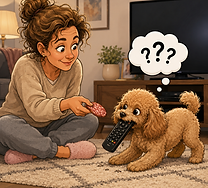
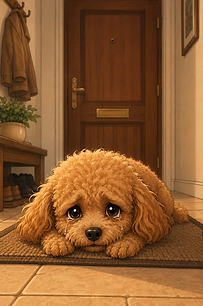
4. Dogs don't understand time the way we do.
You think: “I'm just going out to buy some bread. I'll be back in fifteen minutes.” Your dog has no idea what fifteen minutes means. He doesn't know whether you'll be back soon, later tonight...
or at all. He only sees that the most important person in his world has just disappeared.
That's why some dogs wait by the door. Not because they can tell the time.
Simply because they are waiting.
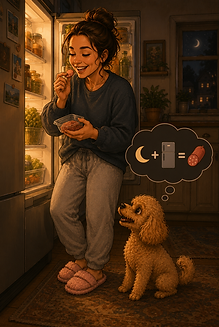
We live by the clock. Dogs live by routines. They don't know what half an hour is.
But they know perfectly well that putting on your shoes usually means it's time for a walk.
That turning off the lights means night has come. And that opening a packet... sometimes means a treat is about to appear. Dogs don't count minutes. They recognize patterns.
5. Your dog lives in the present. The future doesn't exist for him.
We humans spend a lot of our lives remembering the past and planning for the future.
Dogs don't. They don't worry about tomorrow's meeting.
They don't regret not buying a house ten years ago. And they don't make New Year's resolutions.
They live fully in the present. Maybe that's why they still enjoy things we stopped noticing long ago. Perhaps the greatest difference between humans and dogs isn't intelligence.
It's time. We're rarely where we actually are. Dogs almost always are.

6. Your dog doesn't understand words. He learns to communicate with you.
When you say: “Sit.” your dog doesn't translate that word the way a person would.
To him, "Sit" is simply a particular sequence of sounds that, after being repeated many times, always leads to the same action... and often to a reward.
Over time, he learns: “When I hear this sound and do this... good things happen.”
That's communication. Not translation.
Even if you teach your dog to press a button that says: “Mom.” it doesn't mean he understands the concept of "Mom" the way we do. He has learned that making that sound helps him get something. Your attention, for example.
It's a communication tool. Not a conversation.
7. Your dog is learning all the time.
Your dog is constantly making decisions. Not once or twice a day.
Dozens... even hundreds of times. Should I go to my owner or keep sniffing this bush?
Should I chase that pigeon or stay here? Should I listen now... or later?
Every choice has a consequence. And every consequence teaches something.
That's why your dog is learning even when you think you're not teaching him anything.
He learns during walks. While waiting for his food. When visitors arrive.
When you play together. Even when you ignore him.
Dog training doesn't last fifteen minutes a day. It lasts for your entire life together.
You can't decide whether your dog is going to learn something today.
The only thing you can decide is what he's going to learn today.

8. Your dog doesn't need democracy.
Humans love to negotiate.
Dogs would rather know how their world works.
What's allowed? What isn't?
Who makes the decisions? When the rules change every day,
it doesn't create freedom. It creates confusion.
9. If nobody takes the lead... someone has to.
Dogs are social animals. Every social group has a structure. If the owner avoids making decisions or keeps changing the rules,
the dog starts making decisions on his own. Not because he wants to "be the boss." But because, in his eyes, someone has to.
And believe us... that's a responsibility far too big for him.
10. Some situations mean much more than they seem.
Some behaviors look like nothing more than funny little quirks.
To a dog, they may mean something far more important. Does he growl when you approach his food bowl? Does he refuse to get off the sofa? Does he push ahead to go through the door first?
Does he decide when a game starts... and when it ends? Every situation can have a different explanation. There is no single answer. But they all deserve the same question: What does my dog think is happening in this situation? Many people laugh because the dog weighs only three kilos.
They call it "personality." They think it's adorable.
Now imagine exactly the same behavior in a 150-pound Mastiff.
Would it still seem funny? The problem isn't the size of the dog.
The problem is ignoring what lies behind the behavior. Understanding how your dog interprets these situations is far more valuable than simply trying to correct them.

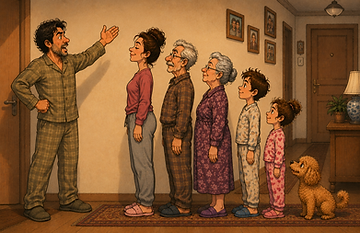
11. The worst role for a dog is not knowing what his own is.
It doesn't matter whether he weighs 4 pounds or 130 pounds.
What creates insecurity isn't being "last in line."
It's not knowing where the line is.
✅ Clarity = Calm.
When a dog understands its place within the household:
it relaxes, it responds better, it learns faster,
there are fewer conflicts.
12. Consistency matters more than harshness.
Five clear rules. Always the same. That gives a dog far more confidence than fifty rules that change with your mood. Dogs cope much better with clear boundaries than with chaos. And remember one thing: Shouting doesn't make you the leader.
It only makes you unpredictable... or even frightening.
A dog may obey because of fear. But he will truly follow only someone he can trust.

The good news is that your dog doesn't expect perfection.
The bad news is that he notices right away when something is allowed today... and forbidden tomorrow.
👉 Understanding Is the First Step to Training. When you understand how your dog thinks, training stops being complicated.

