


Poodle Colors
Toy Poodle colors are one of the most striking characteristics of the breed.
From pure white to deep red,
the poodle shows a wide range of shades
and is one of the few breeds that come in so many colors.
On this page, you will find a clear guide to Toy Poodle colors,
how they change with age, and what you should consider before choosing a puppy.
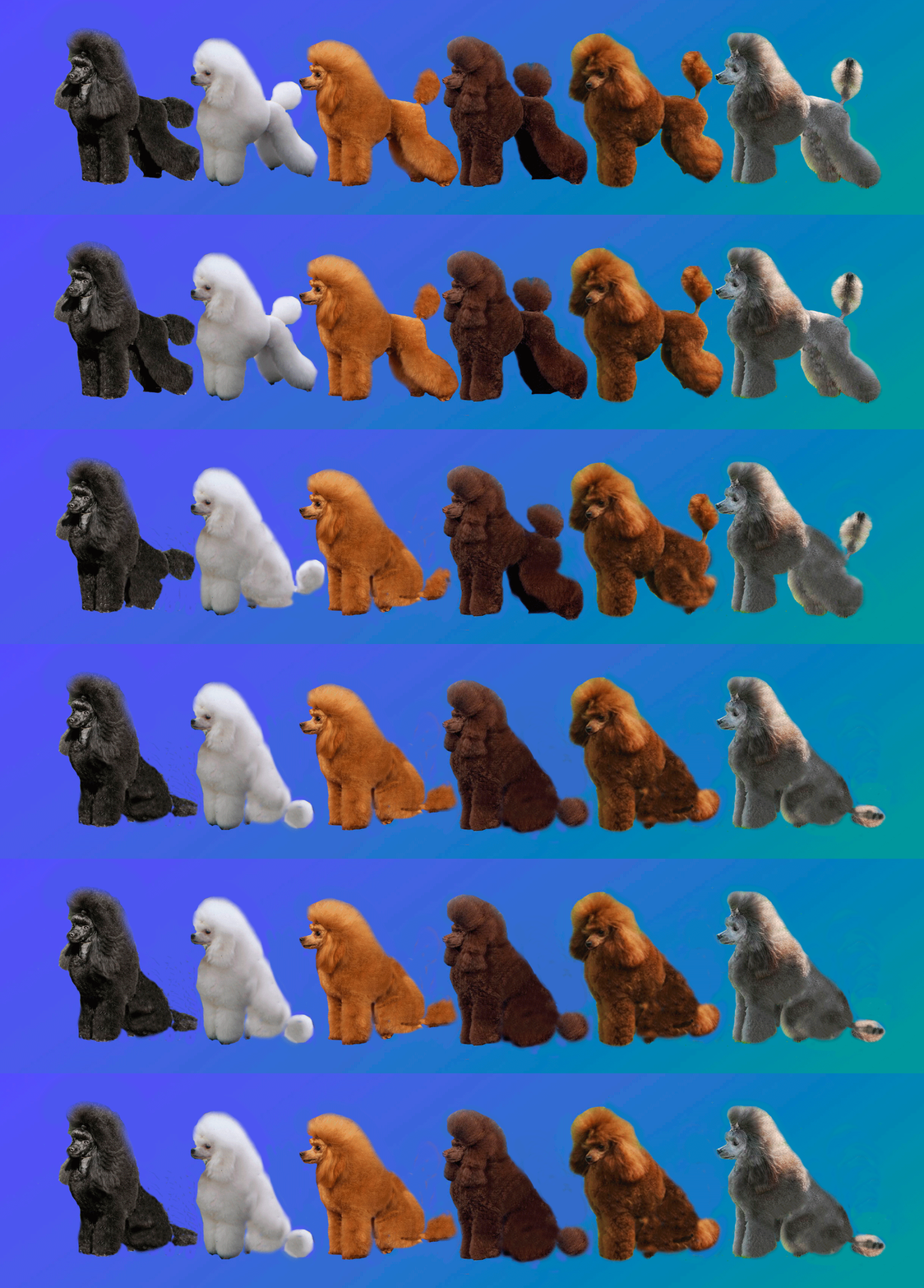
Traditionally, the Toy Poodle was associated with classic solid colors such as:
black, white, brown, gray, apricot, and red.
Today, the standard has evolved and recognizes a wider range of colors, reflecting the true diversity of the breed.

Evolution of poodle colors:
from the classic standard to today’s diversity
The poodle is one of the few breeds whose variety of colors has evolved over time.
What we now see as a wide and rich palette was, for many years, limited by very strict standards.
The history of color in the poodle is not only aesthetic…
it is also about genetics, selection, and a shift in mindset within the world of dog breeding.

Self-Portrait with a Poodle. Rembrandt. 1631. 17th Century.
Origin: historical colors
From its beginnings, the poodle has existed in several colors.
In early representations (17th–18th centuries), we can already see:
- white
- black
- brown
- and dogs with patches (parti-color)
However, with the formalization of breed standards in the 20th century,
a more restrictive view was imposed.
Classic standard (20th century)
For much of the 20th century,
the official poodle standard in Europe
(under the Fédération Cynologique Internationale – FCI)
mainly recognized: ✔ black, ✔ white, ✔ brown.
These were considered the “classic” colors and were prioritized in dog shows.

➕ In the 1960s, the silver colour was added
The inclusion of the silver colour in the official standard did not happen automatically. As with other new colours throughout the breed’s history,
its acceptance was preceded by years of debate among breeders and specialists. Eventually, during the 1960s, silver became one of the colours officially recognised by the FCI.
➕ In the 1970s, the apricot colour was added
The next major step was the recognition of the apricot colour.
Although it was already appreciated by many breeders and enthusiasts,
its official acceptance was also surrounded by discussion.
An interesting fact is that an apricot Poodle won at Crufts in 1966,
one of the most prestigious dog shows in the world.
This success drew attention to the colour and helped demonstrate
that apricot Poodles could compete at the highest level.
A few years later, during the 1970s,
apricot was officially incorporated into the breed standard.


➕ 2007: recognition of the red color
A key moment in the evolution of color was:
2007 — the FCI officially recognizes the red color.
This marks a turning point:
➡️ red goes from being considered a variation of apricot
to having its own identity within the standard.

The Great Fusion of 2015
In 2015, the FCI standard was updated once again. This time, something curious happened: the number of official colours appeared to decrease. In reality, poodles still came in exactly the same colours as before.
What changed was the way they were classified.
Red and apricot were no longer listed as separate colours and were grouped under a single name: fawn.
So no colour actually disappeared. Red poodles remained red, and apricot poodles remained apricot.
The only thing that disappeared was a line from the list of colours in the standard.
➕ ➕ ➕ 2024. The FCI Got Tired of Arguing About Colours 😄
For decades, getting a new colour recognised by the FCI was a slow process. Every addition was accompanied by years of debate, discussions among breeders, and differing opinions about whether that colour should become part of the standard.
That is why the 2024 revision came as a surprise to many people.
Suddenly, the FCI opened the door to a range of colours and patterns that would have seemed unthinkable just a few years ago. Some, such as phantom and harlequin, were already familiar to many enthusiasts. Others, however, are so rare that most Poodle owners have probably never seen one in person.
It almost feels as if, after decades of listening to arguments about colours, someone finally said: “All right, here are all the colours that exist. Now stop arguing about them.” 😄
In addition to the traditional solid colours, the standard now includes patterns such as parti, phantom, tricolour, brindle, and even combinations as uncommon as brindle parti.
If breeders in the 1960s spent years debating the recognition of a single colour, they probably never imagined that one day the standard would end up looking like a complete colour palette of possibilities.

The evolution of color in the poodle is not a recent trend, but a historical process.
What changes is not the dog… but the way we interpret it.


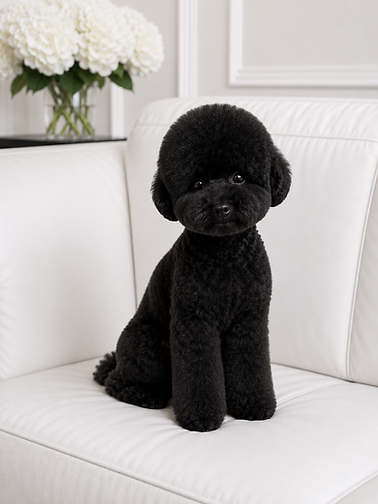
Black Toy Poodle 🖤
Classic Elegance Slowly Becoming Rare
Black is one of the original colors from which the history of the Poodle practically began.
The foundation. The classic look.
The color that for decades was synonymous with a truly impressive Poodle.
But today, things are changing. Everyone wants red.
Or chocolate. Or some other “special” color that stands out more on social media
and in advertisements.
And for many breeders, breeding black Poodles is simply becoming less profitable.
And yet, there is one interesting reality: a truly good black Poodle in the show ring
will often visually outshine an equally good red one. Why?
Because black is probably the most graphic, most contrasting,
and most “sculptural” color a Poodle can have.
Black shows: lines, proportions, angles, silhouette, and grooming work
better than almost any other color.
And in many cases, a good black Poodle also has a richer and denser coat texture
than many modern reds.
Experienced groomers usually notice that immediately.
What Should a Good Black Toy Poodle Look Like?
Let’s put it simply:
👉 A good black Poodle does not turn into a rusty brown hedgehog in the sun. 😄
Even people who know nothing about genetics or morphology usually instinctively recognize the difference between a beautiful black coat and a mediocre one. Black should be: deep, rich, uniform, glossy, and truly black.
Without brown tones. Without reddish fading. Without a dull gray cast.
And here comes something important.
People often say things like: “Oh, the coat just faded a bit in the sun…”
Yes… but in most cases, the sun does not create the problem. It only reveals it.
Because today, truly pure black lines are becoming increasingly rare.
A few enthusiastic breeders still focus on preserving classic black Poodles, but in many breeding programs black is mainly used to improve other colors. And what happens then? Very often, the other colors improve…while black itself becomes weaker.
There is nothing wrong with an adult black dog breeding with, for example, a red female.
But black puppies born from those combinations may already carry polygenes responsible for coat lightening and color fading with age.
In other words: visually, you see a black puppy. Genetically… it may already be a surprise box. 😄
Why Do Some Black Poodles Fade?
This is where the sun becomes part of the story… but not the main villain.
Black color depends on strong and stable eumelanin pigmentation.
When the genetic quality of the pigment is not stable enough, ultraviolet light gradually starts breaking down the pigment inside the hair. That is when the coat begins developing: brown tones, reddish fading, dull areas, or a washed-out black appearance.
So in reality: the sun does not create the problem. The sun reveals the true quality of the pigment.
Other factors can also contribute: age, sea water, coat wear, and coat structure.
Black Poodles and Grooming ✂️
A black Poodle is like an elegant evening suit. Classic. Powerful.
Difficult to ignore.In grooming, black often looks more sophisticated
and visually more “expensive.” It also highlights:
the haircut lines, structure, proportions,
and the groomer’s technical work extremely well.
But here another modern issue appears.
Asian grooming styles and ultra “kawaii” looks usually work more easily
on lighter or warmer colors. Black dogs: hide certain volumes more,
lose some of the “plush toy” effect in photographs,
and make it harder to achieve that cartoon-like baby look.
And yes… this is probably one of the reasons why black Poodles
are becoming less common. Social media today loves:
ultra round faces, baby-like expressions, light colors,
and giant teddy bear aesthetics. 😄
Myths About the Character of Black Poodles
There are many myths about temperament depending on color.
And interestingly… those myths have survived for decades.
Why? Because while color itself does not create personality,
the living conditions and selection of many generations can influence behavioral tendencies.
Historically, black Poodles were often physically stronger and healthier dogs. Even today, they usually suffer from allergies less often than many modern colors. And for many years: they were bathed less often, handled less obsessively,
and people were not constantly trying to maintain the perfect “Instagram look.”
And perhaps all of that affects behavior more than we think. Many old-school breeders describe black Poodles as:
more confident, more resilient, more stable, calmer, and often less picky eaters. 😄
Some people choose a black Toy Poodle simply because they love the color.
Others choose one because it matches the color of their car. 😄 Fashion changes… but I hope classic black elegance lives forever.

White Toy Poodle 🤍
Living Proof That Beauty Requires Sacrifice
White is one of the most spectacular and classic Poodle colors.
Elegant. Eye-catching. Sophisticated. And when you see a truly stunning white Toy Poodle
at a dog show, the very first automatic thought that usually appears is:
👉 “My God… how much work went into this dog.” 😄
Because a truly good white coat is instantly recognizable.
Especially when the dog has: perfectly white moustache,
an immaculate face, spotless legs, and a long coat without the slightest yellow tint.
And yes… even more so if the dog is wearing those huge fashionable white moustaches
that are currently so popular.
White shows: silhouette, grooming lines, proportions, and coat volume extremely well.
That is why white remains one of the colors
most strongly associated with the classic show Poodle.
A White Poodle Is Not “Dirtier.” It Is an Entire Religion 😄
Here comes one of the biggest misunderstandings about white dogs. People often think: “White dogs get dirty more easily.”
Not exactly. They simply live under completely different rules. The care routine for a white Poodle is entirely different from that of other colors. At this point, we enter what could honestly be called: the religion of the white Poodle.
The food is not “sometimes for white dogs.” It is only food for white dogs. Food and water bowls are often plastic because certain metals may worsen staining. Many owners use fountain-style water dispensers so the dog wets the moustache less.
Show dogs often go outside dressed, wearing boots, and if they have long ears, the ears are frequently wrapped and protected as well.
The hair around the eye corners and under the eyes is constantly shaved clean.
Treats are often… the dog’s own kibble. 😄
And if you want to give “just a tiny piece” of something else, you first end up Googling: “Does it contain iron?” “Can it cause allergies?”
“Will it stain the coat?” Carrots, fruits, and many yellow or red vegetables can trigger genuine panic in the owner of a white Poodle before the refrigerator is even opened. 😄
What Should a Good White Toy Poodle Look Like?
A good white coat should not look: yellowish, cream-colored, dull, or “old refrigerator white.” 😄
Beautiful white is: cool-toned, clean, bright, and almost visually glowing.
And interestingly, even people who know absolutely nothing about genetics usually recognize a high-quality white coat immediately.
Why Do Some White Poodles Turn Yellow?
Many factors come into play here. Tears. Saliva. Allergies. Iron in the water. Cosmetics.
Sunlight. Age. Cigarette smoke. Coat quality. And no… purple shampoo is not black magic. 😄
A truly beautiful white coat is usually the result of: genetics, maintenance, cosmetics, nutrition,
and a considerable amount of human obsession. 😄
White Poodles and Grooming ✂️
Here, white has a natural advantage. Asian grooming styles, teddy bear cuts,
baby face looks, and cloud styles often look especially spectacular on white dogs.
Why? Because on white coats: volumes are easier to see,
the eyes appear larger, round shapes stand out more,
and the dog gains that famous cartoon-character appearance.
And this is probably one of the reasons why so many modern grooming trends
became obsessed with lighter colors.
The Character of White Poodles
No. White Poodles are not “nicer.” But many generations living under the famous
religion of the white Poodle may have created an interesting psychological effect.
White Poodles are often extremely manageable dogs. Somewhere deep in their
subconscious, there is probably a message permanently recorded:
👉 “Submit. The human is going to wash you anyway.” 😄
For generations, they have lived with: more baths, more brushing, more cosmetics,
more maintenance, and more human control.
And perhaps that is why many breeders feel white Poodles tolerate endless grooming
routines better than other colors.
The Mysterious Talent of White Poodles for Finding Dirt
And now we arrive at a universal truth: every owner of a white dog is convinced their dog possesses a supernatural talent for finding the single dirty spot on the entire street. A white Poodle can leave the house perfectly clean…
and return five minutes later partially transformed into: beige, gray, suspicious green, or “traumatic life experience color.”
And somehow, the dog always manages to dirty exactly: the moustache, the paws, the ears,
or the one area you cleaned three minutes ago. The white Toy Poodle is luxury.
It is classic elegance. It is something people admire.
And it is simply beautiful.
But honestly… sometimes I look at my white Poodles and think I may have a slight tendency toward masochism.


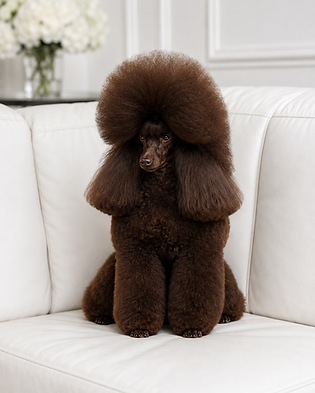
Chocolate Toy Poodle 🤎
The Color That Somehow Looks Delicious
Sometimes it feels as if nature created chocolate Poodles while thinking about:
coffee, hot chocolate, and expensive desserts.
Because a truly good chocolate has something special about it. It feels warm.
Cozy. Soft visually. And somehow simply “delicious” to look at.
What Is a True Chocolate Poodle?
This is where the classic confusion begins. Brown. Chocolate. Café. Liver.
The internet mixes everything together… and in the end almost anything brown gets
called “chocolate.” But a good chocolate Poodle is not dark beige.
A true chocolate should have: a liver-colored nose, amber or hazel eyes,
a warm brown tone, and an even coat color. And something very important:
chocolate should never look grayish, dull, or “washed out.”
Why Are Good Chocolate Poodles Becoming Rare?
Here we enter a slightly uncomfortable… but very real topic.
Unfortunately, breeding is sometimes done by people who are far from genetics and have no desire to understand even the basics.
In the pursuit of the famous “rainbow litter,” different colors are mixed together in hopes of producing more commercially attractive puppies. And that is where the problems begin.
Chocolate with red. Chocolate with apricot. Chocolate with white. “Well… surely it will look pretty.”
And the result? More lightening polygenes. Worse coat quality. Loss of depth in color. Spotting genes. Unstable pigment.
And very often allergies appearing in later generations. Yes, even genetically good chocolate Poodles usually lighten somewhat with age. That part is normal. The difference is that some begin fading at eight years old… while others already look like watered-down cappuccino before they even finish growing.
And then those dogs continue carrying that entire surprise box of unwanted genes and polygenes into the breed population.
Chocolate and Sunlight
Chocolate Poodles also fade in the sun. Sometimes quite noticeably. But interestingly, in chocolates this usually looks less dramatic than it does in blacks. Because slight shade variations can sometimes even look beautiful.
The problem starts when the chocolate coat turns: reddish, grayish, or “tired beige.”
A good chocolate should resemble elegant dark chocolate… not cheap instant coffee.
Chocolate Poodles and Grooming ✂️
If black is an elegant evening suit… then chocolate is an expensive
cashmere sweater. Everything about it feels visually softer and warmer.
That is why teddy bear styles and many Asian grooming cuts look especially cozy
on chocolate Poodles.They naturally have something very “little bear” about them.
And with proper grooming and cosmetics specifically designed for brown dogs,
a good chocolate Poodle can continue looking stunning for many years.
The Character of Chocolate Poodles
Here I am not going to claim that “all chocolates are the same.”
Dogs we bought from different kennels and countries were completely different
from one another.
But if I had to describe my own chocolate Poodles in one word, it would be:
👉 eager-to-please.
The kind of dog that tries to figure out what you want before you even ask.
And when it guesses correctly… it looks absolutely proud of itself.
And honestly, that trait has probably existed in our lines for at least four generations already.
Chocolate is far from being a new color.
But it certainly does not seem ready to disappear either.
It is a cozy color.
The kind of color that makes you want to wrap yourself in a blanket, drink coffee… and walk around the house in soft slippers. 😄

Grey Toy Poodle 🩶
An Aristocrat With an Extremely Long Childhood
Grey Poodles have something special about them. They are not as “plush toy” as whites.
Not as warm and cozy as chocolates. Grey has a completely different aesthetic.
Calmer. More elegant. More… aristocratic.
And grey is probably one of the few colors that nobody truly understands
while the dog is still a puppy.
Because you buy an almost black puppy…
and then spend years waiting for the famous grey to finally appear.
A grey Poodle spends its entire youth slowly “unpacking” that expensive oversized coat
it apparently bought for the future.
What Is a True Grey?
And here the internet once again creates complete chaos. Silver. Grey. Blue.
Smoke. Platinum. And eventually everything gets mixed together as if all of it were exactly the same. But a good grey should be: cool-toned, clean, even, without brown tones, without muddy shades, and definitely without the famous “wet mouse” look.
A beautiful grey should resemble: smoke, silver, wet asphalt after rain, expensive cashmere, or brushed steel.
It has a very calm and very elegant aesthetic.
Why Are Grey Poodles Born Almost Black?
And here comes one of the biggest surprises for owners.
Because grey Poodles are usually born: black, very dark,
or sometimes almost charcoal-colored.
And then the transformation begins. Very slowly.
Owners of grey Poodles spend the first years of the dog’s life
permanently asking:👉 “Okay… but where exactly is my grey?” 😄
Because the real color appears gradually.
Sometimes over several years.
The Genetics of Grey Poodles
Now we arrive at one of the most interesting parts of the story. Grey Poodles suffer much less from the famous “commercial breeding experiments” created by people who do not understand genetics.
Why? Because grey has its own personal color gene. The famous progressive greying gene — G.
And if that gene is not present… there will be no greys. Most other colors simply do not carry it. Except white.
And interestingly, grey + white combinations often work extremely well.
Because something unusual happens here: both colors act as improvers. It is not the usual situation where one color improves another while damaging itself in the process. Here both colors can actually benefit each other.
And the funniest part is that about ten years ago genetics still did not fully understand this.
For a long time people believed grey was somehow related to agouti.
Why? Because crossing greys with apricots sometimes produced very strange dogs: almost black, with extremely pale phantom markings, or dogs called sable, raccoon, and many other creative names… when genetically they were basically textbook agouti.
And now comes the real problem. Grey strongly worsens almost every color except white.
Because it carries the progressive greying gene… where in many cases it simply should not exist.
So, for example, a grey + apricot breeding can create a true: “caput pack” for color genetics. 😄
A lightening gene plus lightening polygenes together. And in the end you get what could lovingly be described as:
a sort of “genetic trash-can dog.”
Meaning: far too many unrelated things mixed together at once.
Grey Poodles and Age
Grey matures slowly. Very slowly. And not only the color. The entire visual image of the dog develops slowly.
Many grey Poodles do not fully “finish assembling themselves” visually until three or even four years old.
And that surprises many owners enormously.Because while other colors already look completely finished… the grey is still changing.
Grey Poodles and Grooming ✂️
If black is an elegant evening suit…then grey is an expensive cashmere coat.
Everything about it looks calmer and more sophisticated.
Grey especially highlights: lines, transitions, textures,
and elegant proportions. It has something very European. Very classic.
The Character of Grey Poodles
I honestly do not know exactly why this happens.
But sincerely, all my grey Poodles — including dogs purchased from
completely different kennels and different parts of the world — shared
one common trait: calmness. I would even say: philosophical.
The multicolored dogs run straight into the puddle.
The greys usually stay behind first evaluating the situation:
“Is it really worth going there at all?”
And we are not talking about five dogs here.
We are talking about a very large number of dogs over many years.
And there is another interesting detail:
all of my longest-lived dogs — including the oldest one,
who reached 22 years old — were grey.
Grey Poodles teach one very simple thing:
some beautiful things in life take time to appear.


Apricot Toy Poodle 🧡
A little sun you can carry in your arms
Sometimes it feels as if apricot Poodles were not created by breeders…
but by marketing specialists. Because: teddy bear, baby face,
Asian grooming, and the famous “living plush toy” effect…
all truly exploded in popularity specifically with apricot dogs.
And honestly, a huge part of the modern Toy Poodle’s internet fame
was built on this color.
What Is a True Apricot?
And here begins another classic internet war. Red. Apricot.
Cream. Dark apricot ultra red exclusive VIP special edition.
Yes, according to the modern standard, apricot and red are officially
considered the same color. Although the standard itself spent many years
changing its mind: sometimes separating them,
sometimes combining them again. But we have been breeding them
separately for far too long to suddenly start mixing everything together
every time the standard changes again.
We will talk about reds separately. A good apricot should be:
warm, even, glowing, without gray tones, without dirty beige shades,
and definitely without the famous “dusty faded carrot” look.
Why Are Apricots Everywhere Today?
Because the internet completely fell in love with them. Asian grooming. Teddy bear cuts. Baby face styles. Instagram dogs.
TikTok dogs. All of this turned apricot into the most commercially popular Toy Poodle color in the modern world.
And here another problem began: many breeders started breeding “an image”… instead of breeding dogs.
The Genetics of Apricot
And now comes the fun part. The main problem with many “spontaneous breeders” is not the color itself. It is the fact that many of them have never even heard about polygenes. They do not truly understand what inbreeding is. And usually the stud dog becomes either: their own male for every female, or simply “the reddest male living nearby.” Fashion. Commerce. Marketing.
And then one day the surprise arrives. Suddenly it turns out that both parents share: a common white grandfather and a dirty cream grandmother somewhere close in the pedigree. And then: 👉 hello genetics. goodbye large amounts of money. Because trying to “improve” color without understanding how it actually works is roughly like:
repairing a pipe in a zoo… and unexpectedly ending up delivering a baby elephant.
Apricot and Age
Almost all apricots lighten with age. The only question is: how much.
Good lines usually lighten beautifully and evenly. Bad lines… well…sometimes
the bright puppy eventually turns into something resembling a tired cappuccino.
Apricot and Grooming ✂️
Now the real party begins. Teddy bear. Asian grooming. Baby face.
All of this is practically the natural habitat of apricot Poodles.
Because apricot visually feels: warmer, softer, more childlike,
and more “hug-friendly.” And yes… the global “cute dog” industry probably
earned millions thanks to apricot Poodles.
The Character of Apricots
Honestly, with apricots I personally do not see any clear personality pattern.
In fact, this is exactly the color where my own dogs — as well as dogs purchased from completely different kennels and countries — differed enormously from one another. Like night and day. But there is one thing I notice fairly often:
coat quality in apricots is frequently weaker than in many other colors.
Apricot and Real Life
Apricot Poodles possess a very special talent. Even while actively committing crimes… they still somehow manage to look adorable.
And honestly: even when your little sunshine steals an entire roll of toilet paper and happily redecorates the entire apartment with it…
you still end up standing there smiling at the tiny criminal.
Sometimes it feels as if apricot Poodles exist for only two purposes:
conquering the internet… and emotionally manipulating humans with their eyes.


Red Toy Poodle ❤️
The Color the Entire World Fell in Love With
Years ago, red Poodles were a rarity. Today, red is probably
the most commercially desired Toy Poodle color in the world.
Instagram. TikTok. Asian grooming. Teddy bear. Baby face.
All of that pushed red Poodles directly into superstar status.
And honestly, there was a moment when the word “red”
started selling puppies almost better than pedigrees.
What Is a True Red Poodle?
I already mentioned before that for years federations could not decide what
exactly to do with red and apricot colors. Sometimes red was considered
a separate color. Then it was merged with apricot. Then things changed again.
And the current standard eventually solved the problem by simply placing
them all under: “leonado.” My personal theory: about why this happened?
Because they themselves did not really know how to describe them. Because
there is no simple: “red gene” or “apricot gene” working like an on/off switch.
Here we are dealing with: modifiers, polygenes, pigment intensity,
genetic accumulation, and color stability.
And those things are still being studied today.
So eventually the standard started creating very awkward situations. For example: a young dog wins championships as a “red”…
and two years later you would be embarrassed to even show it as an apricot. Or the opposite: a puppy is born looking completely apricot, and then slowly begins darkening… darker… darker…until it becomes a deep intense red.
But all its titles were originally earned as an apricot. So… 👉 who is the fool? FCI is the fool. 😄
And eventually they simply chose the easiest solution: 👉 “Everybody is leonado now. Figure it out yourselves.”
A true red should be: deep, rich, warm, intense, and even in color. It is not simply “a darker apricot.”
Why Did Red Become So Popular?
Because red fit perfectly into the modern world. Asian grooming. Teddy bear styles. Baby face cuts. Instagram dogs.
A red Poodle literally looks as if nature specifically designed it for social media algorithms.
It is almost impossible not to stare at one.
Red Genetics — Where the Chaos Begins
And now we arrive at the fun part. The real chaos is not created by the color itself. It is created by chaotic commercial breeding.
Because many “spontaneous breeders” do not even truly know what polygenes are. And they understand inbreeding even less.
So the classic formula appears: white female + red male.
And yes, sometimes the puppies are born looking quite red.
The fact that by one year old only the ears remain red usually does not enter the commercial calculations. And here comes the uncomfortable part: to truly remove the genetic “package” left by a white dog may require around seven generations of careful selection. But commercial breeding usually does not enjoy waiting seven generations.
And that is where everything begins: strange fading, loss of intensity, weak coats, unstable color,
and dogs that visually appear red…
while genetically being complete chaos. Because trying to improve color without understanding how it works is roughly like:
repairing a pipe at the zoo… and unexpectedly ending up helping an elephant give birth.
Red and Age
Yes. Almost all red Poodles fade with age. All of them.
The only questions are: how much, how quickly, and how
beautifully it happens. Good reds age elegantly. Bad ones… well…
sometimes a super red puppy eventually becomes “formerly red.”
Why Is a Good Red So Expensive?
Because a truly stable red does not appear by accident.
Behind it there are usually: many years of selection,
accumulated modifiers, pigment work,
coat work, and enormous amounts of genetic filtering.
And yes: sometimes the price genuinely reflects generations of work.
Although sometimes… it simply reflects a very confident seller.
Red and Coat Quality
Here another common problem appears. Many reds have:
softer coats, less density, less volume,
and greater difficulty maintaining proper show texture.
Sometimes it feels as if extreme color “charges its price”
specifically through coat quality.
The Character of Red Poodles
Personally, I do not believe the red color automatically creates a specific
personality. Something else plays a much bigger role here:
the type of owners this color attracts.
Most people choosing other colors usually first decide: “I want a Poodle.”
And only afterward choose the color.
With reds, it is often the opposite.
People simply want: “the adorable little red dog.”
And honestly, many do not particularly care whether it is a pure Poodle,
a Maltipoo, or something else entirely — as long as it is small, red, and cute.
Which also means many owners never really study the breed itself.
And of course… a Poodle is one of the smartest dog breeds in the world.
If an extremely intelligent dog spends ten hours alone at home and then gets a five-minute walk…it is probably going to become emotional. And since social media contains far more owners than breeders…that is exactly how myths about
“overly emotional reds” are born. Sometimes it feels as if red Poodles know perfectly well how spectacular they look…
and honestly… they use that fact shamelessly.


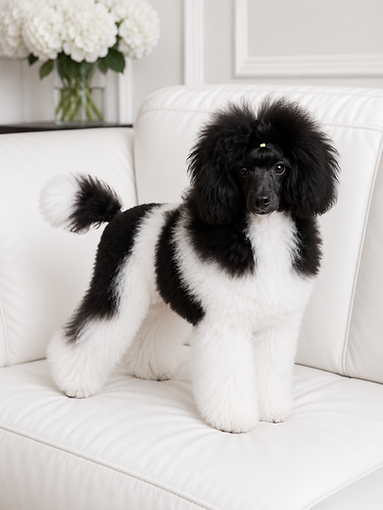
Parti Toy Poodle 🤍🖤
The Color That Is Impossible Not to Notice
Parti-colored Poodles have always existed. Old photos, old bloodlines,
old paintings… they were there from the very beginning.
But officially, the FCI recognized them only very recently.
Only in 2024 were parti colors finally officially accepted.
Which makes the whole situation rather funny:
the color had quietly existed for decades…
while the official “fine, let them live” arrived only recently.
Because yes… the history of parti Poodles has always been full of arguments.
What Is a True Parti Poodle?
First, it is important to explain something clearly:
a parti is NOT simply “any spotted dog.”
There is a very specific distribution of white and color.
A true parti has: a white base, well-defined colored patches,
and predominantly white legs. And here comes a very important detail:
parti colors should not be confused with mismarks.
Because: a colored leg with a white sock is NOT a parti.
That is called a mismark. And in solid-colored Poodles, it is considered a fault.
Meanwhile, in parti Poodles it is perfectly acceptable to have: a small colored spot on an otherwise white leg.
And yes… even parti Poodles still have rules. For example:
the famous “pirate markings” around one or both eyes are still considered undesirable even in parti colors.
So even “artistic chaos” still comes with official instructions.
The Long History of Arguments
Parti Poodles have always caused controversy. Sometimes they were considered: “incorrect Poodles.”
Other times: “damaging to the breed.” And then came one especially funny stage somewhere between “forbidden” and “allowed”:
suddenly people started calling them “harlequins.”
Apparently it was psychologically easier to accept a “new elegant name” than to admit that spotted Poodles had existed all along.
But Poodles never bothered reading breed standards. So they simply continued producing parti puppies anyway.
Parti Genetics
Now we arrive at another interesting subject. Because parti coloring is not a “broken color.” It is simply the work of white spotting genes. And parti Poodles have one particularly entertaining habit: they expose hidden genetics within bloodlines.
Because if spotting genes existed quietly somewhere in the pedigree for generations… eventually they will appear.
And then comes the classic breeder moment: “How is there suddenly a parti puppy if my line was completely solid-colored?”
Which is usually followed by emergency pedigree investigations.
Why Are Parti Poodles Popular Again?
Because the internet loves: uniqueness, contrast, individuality,
and dogs that are impossible to ignore. Every parti is different.
No two are exactly alike. And they also come with
a very practical advantage: many people dream about having
a white Poodle… but do not want to live permanently in:
“tear stains-whiskers-shoes-wet wipes-water fountain mode.”
And this is where parti Poodles become the perfect compromise.
Because they usually: get dirty less than whites,
have fewer tear stain problems, are often less prone to allergies,
while still keeping that bright dramatic appearance.
Parti and Grooming ✂️
Now we enter an entirely different level of difficulty.
Because patches completely change visual geometry.
A groomer working on a parti is not simply shaping the dog.
They are also shaping: color placement.
Lines must adapt to the markings. Visual balance changes.
And sometimes the groomer practically has to “trick the eye.”
Because one badly positioned patch can completely alter
the perception of the dog. So parti grooming is the exact moment when a groomer suddenly realizes they are trimming:
dog + abstract art project at the same time.
The Character of Parti Poodles
Owners of parti Poodles are almost always convinced of one thing: “partis have special personalities.”And honestly… maybe they are right. Although it is admittedly difficult to be boring when you already look like a walking art project.
Parti Poodles and Dog Shows
Arguments about parti Poodles will probably never disappear completely. In some places they are adored.
In others they still cause endless debates. But honestly, parti Poodles waited far too many years to become invisible again.
Sometimes it feels as if nature created parti Poodles on the exact day it became completely tired of painting dogs in only one color.

Toy Poodle Phantom 🖤🤎
The Color "Stolen" from Dobermans
Someone looked at a Doberman, a Rottweiler and thought, "What a beautiful color." Then the Poodle stole it, added curls, softness and considerably more charm.
Phantom is not a new color. It has existed for decades. The only thing that is new is that the FCI finally decided in 2024 to officially recognize something it had been seeing without really seeing for many years.
And truth be told: it looks absolutely spectacular on a Poodle.
What Is a Good Phantom?
A good phantom has clear, well-defined markings with strong contrast. If you need a magnifying glass to find the phantom markings, something has gone wrong.
The tan points should be visible. That is literally the whole point of the color.
And yes, white markings are still considered a fault. A phantom may look very elegant, but if it decided to add white socks or a white patch on the chest all by itself, the FCI still does not appreciate that particular form of creativity.

The at Gene
The phantom color is produced by the at gene. And here comes one of the most common misunderstandings: phantom puppies do not appear because certain colors are mixed together.
A black Poodle and a red Poodle can produce phantom puppies. A white Poodle and a black Poodle can do the same. Even two colors that seem completely unrelated to phantom can produce phantom offspring.
The only thing that really matters is that both parents carry the at gene. Colors can be misleading. Genetics usually isn't.
Toy Poodle Tricolor 🖤🤎🤍
The Color That Was Recognized Almost Before It Was Found
The tricolor was officially recognized by the FCI in 2024. The funny part is that many enthusiasts had gone years without seeing a real one, and some didn't even know it existed.
Unlike particolors or phantoms, the tricolor has always been more of a rarity than a common color. It would appear from time to time, surprise everyone, and then disappear again.
And now that breeding for it is finally allowed, an unexpected problem has appeared: finding good examples is still more difficult than obtaining FCI approval itself.
In fact, even today there are more discussions about tricolors than photographs of truly good tricolor Poodles.
What Is a Tricolor, Really?
This is where the confusion begins.
A phantom with a white patch on the chest is not a tricolor.
A phantom with white toes is not a tricolor either.
That is still a phantom with disqualifying faults.
For a true tricolor, three colors must be clearly visible: the base color, the phantom tan markings, and the white areas of the particolor pattern.
In other words, a tricolor is not a phantom that accidentally got splashed with white paint.
It is a phantom and a particolor at the same time.

Tricolor Genetics 🧬
To produce a tricolor, the at gene responsible for the phantom pattern is not enough. The gene responsible for white spotting is also required. And this is where things stop being simple.
Because white markings can appear both in a particolor and in a Poodle with disqualifying faults: a white chest, white toes, or small white markings.
At first glance they may look similar. Genetically, they probably are not.
Everything suggests that modifier genes and polygenic factors also play a role, influencing both the amount and the distribution of white.
And that is precisely one of the least studied areas of coat color genetics.
Theory tries to explain it. Breeders have been trying to understand it for decades.
Brindle Toy Poodle
The Most Controversial Color in the Poodle World
Yes, nature truly seems to enjoy strange experiments with stripes.
And in some breeds brindle is completely normal and historically natural.
French Bulldogs. Bull Terriers. Boxers. Cane Corsos.
In all of them, brindle is considered one of the basic colors.
BUT. And this is where the main question begins.
How did the brindle gene appear in Poodles at all?
Especially in a breed that spent more than a hundred years existing
primarily in solid colors. Theoretically… yes, it could have appeared.
Is the probability small? Yes. Impossible? No.
Because genetics works in a far more complicated way than
the internet would like. If twenty or thirty years ago someone introduced
a brindle-carrying breed into a line…
and then spent generations breeding back only to Poodles…
after twenty generations a genetic test could very easily say:
👉 “purebred Poodle.”
While the unusual gene still quietly remains inside the line.
And yes… since 2024 brindle has officially been accepted by the breed standard.
But judging by the internet reaction…
it is very clear that not everyone has emotionally recovered from this yet.
Personally, I never owned any brindles. But I did see them in other kennels. And some dogs personally raised questions for me.
One had ears that felt too heavy. Denser and longer than I would normally expect in a good Toy.
Another had a slightly long body and bone that looked too wide for such a small dog. And another important detail:
we owned Mini Bull Terriers and still have French Bulldogs.
So I understand very well how difficult brindle can be to remove from genetics once it enters a line.
That is exactly why I never had them myself. And most likely never will.
But for the sake of fairness, I still included them in this color review.
What Exactly Is Brindle in Poodles?
Brindle is NOT spotting. NOT phantom. NOT sable. It is specifically a striped pattern. And it can appear in very different ways.
The stripes may be: very bold, almost invisible, blurred, high-contrast, or completely chaotic.
Some brindle Poodles look like elegant little tigers. Others look as if the dog was lightly printed by an emotionally exhausted printer.
And the funniest part: the pattern can change dramatically with age.
Brindle Genetics — Where the Internet Completely Loses Its Mind
This is where the real entertainment begins. Because officially brindle is now recognized by the standard.
But the discussion about how exactly this gene appeared in Poodles… will probably never end.
The brindle gene absolutely exists. K locus. Kbr. That part is not fantasy. But after that the endless arguments begin:
Is it an ancient hidden breed gene? Is it the result of historical outcrosses? Or somehow both at the same time?
And honestly… the internet discusses brindle Poodles with such extreme passion,
that sometimes it feels less like a dog conversation… and more like a classified government project.
Why Are Brindle Poodles So Rare?
Because very few people genuinely work with this color. And even fewer people truly understand how it behaves genetically.
Especially on: red, apricot, and silver.
Brindle may: intensify, fade, almost disappear, or suddenly appear unexpectedly.
Sometimes a breeder expects a spectacular little tiger… and instead gets a dog colored like: “slightly nervous cappuccino.”
Brindle and Grooming ✂️
This is where groomers begin suffering a little. Because stripes completely destroy visual geometry.
They can: emphasize lines, ruin volume, make the dog appear wider, shorter, or simply strangely distorted.
Which is why sometimes a groomer working on a brindle looks like a person trying to trim:
a dog and an optical illusion at the same time.
Brindle and Dog Shows
Yes, since 2024 brindle has officially been accepted by the breed standard. But that absolutely does not mean the arguments suddenly disappeared. Some breeders calmly accepted the new standard. Others — absolutely not.
Meanwhile the internet continues burning enthusiastically.
Sometimes it feels as if brindle Poodles generate more genetic debates… than certain scientific conferences.
The Character of Brindles
Owners of brindles are almost always convinced of one thing: “brindles have a special personality.”
Although honestly it is probably difficult to feel like a completely ordinary dog…
when you already look like modern designer jungle furniture with legs.
Brindle and Real Life
Brindle owners quickly become tired of answering: “Wait… is that really a Poodle?”
And sometimes it feels as if brindle Poodles do not go outside for walks at all… but instead conduct daily educational seminars on color genetics for the entire neighborhood. Brindle Poodles are definitely not loved by everyone.
But honestly… they almost never leave people indifferent.

Merle Toy Poodle 🌌
The Color the Internet Will Never Stop Arguing About 😄
If brindle causes arguments…
merle starts full-scale genetic wars. 😄
Because here we are no longer talking about “just a controversial color.”
👉 Merle is NOT officially recognized in Poodles.
And most serious breeders and geneticists believe the gene entered the breed through crosses with other breeds.
And honestly… this discussion will probably never end. 😄
Because visually, merle can be absolutely stunning.
And that is exactly where the problem begins. 😄
What Exactly Is Merle?
Merle is not ordinary spotting.
Not phantom.
Not parti.
👉 It is a marbled pattern.
Diluted areas.
Broken patches of color.
Blue eyes.
Odd eyes.
Butterfly noses.
And very often the visual effect is so dramatic…
that people stop thinking genetically
and start thinking only:
👉 “wow.” 😄
Why Does Merle Cause So Much Drama?
Because merle is not a subtle gene.
It is not something that quietly “hides” inside a breed for a hundred years without anyone noticing.
Merle is basically:
👉 “HELLO EVERYONE, I AM MERLE.” 😄
Which is exactly why many breeders consider it unlikely that the gene historically existed in Poodles without being clearly documented long ago.
And this is where the endless internet war begins:
Was it an ancient hidden breed gene?
Or did it arrive through historical outcrosses?
And honestly…
the internet debates merles with such extreme passion,
that sometimes it feels like a strange combination of canine genetics and medieval religion. 😄
My Personal Experience With Merle
Around ten years ago I bought a merle Toy Poodle from an American breeder.
And honestly:
the dog himself was correctly built.
He did not look like an “obvious mix.”
Visually, he looked like a fairly typical Toy Poodle.
Although there were a few interesting details.
👉 The teeth were stronger.
👉 And they changed earlier than usual.
We decided to experiment and produced several litters from good purebred females with champion pedigrees.
And this is where things became interesting.
In EVERY litter there were puppies that from birth did not fully resemble the Toy type we were used to seeing.
Higher birth weight.
Thicker legs.
Coarser heads.
And in every litter there were merles.
And here I want to be very clear:
👉 I am NOT saying “all merles are bad.”
I am simply describing what I personally observed during our experiment.
And honestly…
that is where our experiment with merles ended. 😄
Merle Genetics — Where the Real Problems Begin 😄
Because the problem with merle is not only its origin.
There is also the issue of double merle.
And here things become much less entertaining:
hearing problems,
vision defects,
developmental abnormalities.
Which is why responsible breeders do not treat merle as simply:
👉 “a fashionable color.”
Instead, they see it as a gene requiring extremely careful and knowledgeable breeding. 😄
Why Is Merle So Popular?
Because social media absolutely loves merle.
Rarity.
Blue eyes.
“Wow effect.”
Exotic appearance.
Sometimes it honestly feels as if Instagram algorithms would personally pay bonuses for blue-eyed merle Poodles. 😄
Merle and Grooming ✂️
Merle can look incredible in grooming…
or completely destroy visual structure. 😄
Sometimes it highlights amazing lines.
Other times it feels as if the groomer is trying to trim:
👉 a watercolor painting with legs. 😄
Merle and “Purebred Genetics”
Here comes another uncomfortable subject.
A genetic test can absolutely show:
👉 “purebred Poodle.”
But if an unusual gene entered the line many generations ago…
over time the trace of that old cross may disappear from genetic testing.
👉 The gene remains.
👉 The history does not. 😄
Merle and Real Life 😄
Merle owners receive:
huge amounts of attention,
millions of questions,
and even more opinions. 😄
Sometimes it feels as if a merle Poodle does not go outside as a dog…
but as a walking internet comment section. 😄
People may love merle Poodles…
or dislike them completely.
But one thing is absolutely certain:
👉 they almost never leave anyone indifferent. 😄
