

Toy poodle grooming
· guide and styles
Types of grooming, maintenance and practical advice
based on real experience.


Haircut.
The poodle’s haircut did not originate as something decorative. Originally, the poodle was
a water dog, used to retrieve game from lakes and rivers.
Its trim had a very specific function:
👉 the hair on the chest protected it from the cold
👉 the “pom-poms” on the legs helped with movement in the water
👉 and the rest of the body was clipped to make swimming easier
Nothing was aesthetic. Everything had a practical purpose. Over time, this functional trim evolved into the styles we know today. But the origin remains the same.
Over time, this functional trim stopped being purely practical and opened the door to something completely different. Thanks to the structure of the poodle’s coat and the amount of hair it has, it becomes one of the breeds with the greatest grooming possibilities.
Not all breeds allow this. The poodle’s coat grows continuously, has volume and texture, and makes it possible to shape forms, lines, and proportions. Each cut can completely change the perception of the dog: its silhouette, its expression, its style.
From the most practical… to the most creative.
Types of coat in the poodle.
In practice, there are two main ways to maintain a poodle’s coat.
The most well-known is the one everyone recognizes: soft, fluffy, and full of volume.
It is the classic image of the poodle,
the one seen in most trims.
But there is another, less common option:
coat worked into fine strands (corded or in small cords).
Both options come from the same type of coat,
but the maintenance and the visual result are
completely different.
And most importantly: any haircut can be adapted to both types of coat.
It is not the style of the cut that changes, but the way
the coat is worked. The corded coat is not a modern trend.
It is part of the poodle’s history. It can already be seen in early representations of the breed, where the coat was worked into cords.


Technique for forming cords (corded coat)
in the poodle.
The corded coat does not form naturally without control.
It is a process that requires manual work and consistency.
The goal is to separate the coat and guide it to form fine,
defined, and uniform cords from the root.
1. When to start. It should begin when: the puppy has already changed its coat
(approximately between 8 and 12 months), the coat has sufficient length
(minimum 8–10 cm), the texture is curly and dense.
If started too early, the cords will not hold. If started too late, the coat mats
into plates that are difficult to correct.
2. Coat preparation. Before starting: bathe with a mild shampoo, avoid heavy conditioners, dry the coat completely, do not brush once the process has begun. Brushing breaks the natural formation of cords.
3. Manual separation. This is the most important step: divide the coat with your fingers, not with a comb. Create small sections (about the thickness of a pencil or finer). Follow the natural direction of hair growth.
Goal: fine cords, uniformity across the whole body, avoid thick mats.
4. Forming the cord. Each cord should: be separated from root to tip, be lightly twisted with the fingers if necessary, remain natural, without forcing it. The goal is not to create artificial ropes, but to guide the coat so it organizes itself.
5. Daily maintenance. During the first weeks: check the cords daily, separate manually any that start to join together.
Pay special attention to: armpits, behind the ears, groin area. These areas tend to form mats more quickly.
6. Bathing with cords. Once formed: you can bathe normally, do not brush afterward, after bathing: dry with a towel without rubbing,
separate the cords manually, let them air dry or use a gentle dryer.
Toy Poodle haircuts: how their appearance
changes completely.
The Toy Poodle is one of the few breeds that can be completely transformed depending on the haircut. With the same dog, the same structure, and the same size, it is possible to achieve completely different styles.
In this video, you can see how a poodle changes with different types of trims and understand why grooming is not just about aesthetics, but an essential part of the breed. You will see how: the silhouette changes, proportions are highlighted or softened. The same dog can look like a completely different one.


Poodle haircuts: before and after
the new FCI 2024 standard
The poodle has always been one of the most versatile breeds when it comes to grooming.
For decades, there were well-defined classic trims that set the standard in dog shows
and breeding. However, with the update of the FCI standard in 2024,
not only aspects of color and coat variety have been revised,
but also the way the dog’s presentation is interpreted.
Today, the focus is clearer: it is not about competing in grooming,
but about respecting the poodle’s structure, type, and natural appearance.
Before the current standard: more defined and structured trims predominated, greater
emphasis on shape and visual effect, very specific styles depending on show requirements.
With the FCI 2024 standard: excessive grooming is avoided,
a more natural and balanced look is preferred,
the trim should complement the dog, not disguise it.

Lion Clip
In these illustrations, we show the fundamental difference between the old standard and four variations of the clip
that can be performed under the new standard.
In this way, we aim to make it easier to interpret the wording
of the 2024 standard, which is not always entirely clear.
Previously, although this clip was permitted by the FCI,
it was very rarely seen in shows.
Most breeders and groomers preferred the so-called “Scandinavian Lion,” as it appeared more striking,
balanced, and elegant in the ring.
However, with the new standard, the situation may change.
The former “Scandinavian Lion” is no longer described as such, but as the “Scandinavian or Terrier clip,” and it has also undergone significant changes in its form.
For this reason, the classic Lion Clip is likely to begin
appearing more frequently in shows,
as the “Scandinavian” style has lost part
of its traditional and ornamental appearance.


Scandinavian or Terrier Clip
Previously known as the “Scandinavian Lion,” it was for many years the most common clip in dog shows.
It remains to be seen whether it will maintain that popularity under the new standard.
The change in name and concept raises a certain question: wouldn’t it be simpler to have a terrier than to turn a poodle into one?
According to the standard, it is a clip similar to the Modern, with the difference that the ears and tail may be shaved.
But if they may be… they may also not be.
In that case, the difference from the Modern clip disappears, which leaves, to say the least, a rather curious formulation.


English Clip (comparison with the old standard)
The “English Saddle” of the old standard was, without a doubt, one of the most striking and spectacular clips.
It was also one of the most complex when executed correctly.
Today, it no longer exists. It has become part of history.
In its place, the new standard reduces it to just six lines and introduces a new “English clip,” whose main difference is the possibility of adding bracelets and cuffs on the hind limbs. The moustache is optional, as is the topknot.
Thus, we move from the peak of poodle grooming… to six lines of description.


Puppy Clip
In reality, this clip has hardly changed in the new standard.
The only notable differences are that the tail pom-pom must now
be strictly oval, and that leaving a moustache is now optional.
However… the descriptions have changed,
and not exactly for the better.
Expressions such as “a ball comparable to an egg” or the almost
complete lack of guidance regarding the hindquarters can be, at the
very least, confusing even for those with experience.
For this reason, we have prepared this illustration: to translate
the standard into a clear visual language and to show how the clip should
actually look once these… rather peculiar formulations are interpreted.

Modern clip.
If the standard is analyzed carefully, there is an interesting detail: almost all descriptions of the other clips end up referring,
directly or indirectly, to the Modern clip. This makes it quite easy to understand the logic of the new standard.
👉 The Modern becomes the foundation. And the rest of the clips are, essentially, small variations of that foundation.
In other words, the standard seems to suggest that this is the most desirable clip from a modern perspective: the one that best shows the dog’s structure, with fewer decorative elements and less room for interpretation.
The other styles — Lion, English, Puppy, or Scandinavian — are presented more as adaptations, designed to preserve
some variety without straying too far from this “main” form.
And here an interesting nuance appears. For those accustomed to the richness and spectacle of classic trims, the feeling is almost like being granted a concession: not a complete rejection, but rather a quiet “you may continue playing a little… but within these limits.”
Those styles may have been more elaborate — even excessive for some — but they were also undeniably beautiful and required an extremely high level of technique.
And with this change, an inevitable question arises:
👉 How long will it be before truly skilled specialists capable of performing an “English Saddle,” at the level once considered the pinnacle of grooming, begin to disappear? An interesting evolution… though not without a certain sense of nostalgia.
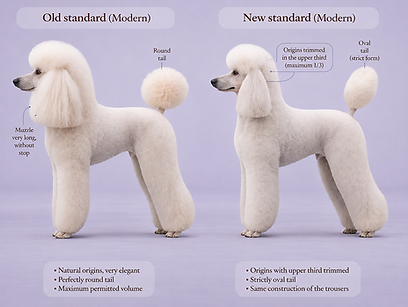
It is not about deciding whether it is better or worse. But it is difficult not to see in this change the end of one era… and the beginning of another in the history of the Poodle.
Asian style in the poodle
💬 If we speak honestly…
In these styles, a freedom that used to be common in show clips is preserved today.
Different approaches, different schools, different ideas…
but the same foundation: the poodle as the perfect canvas for grooming.
🧭 Where does the Asian style come from?
Although today everything is often grouped under the term “Asian style,” it did not emerge all at once or in a single place.
👉 It started in Japan.
👉 Then Korea took it to another level.
🇯🇵 Japan — the origin (kawaii)
The Japanese style began to develop around the late 1990s and early 2000s. And, as expected…
👉 it did not come from cynology, 👉 it came from Japanese visual culture: kawaii, characters, “cute” aesthetics, non-realistic proportions.
The goal was not to show the dog. 👉 The goal was to create an expression.
🎯 What defines the Japanese style?
rounded faces, visually enlarged eyes, softened muzzle, plush-like volumes, soft lines, no tension.
👉 everything is designed to make the dog look: younger, sweeter, almost… like a cartoon.
🇰🇷 Korea — evolution (and complication 😏)
Korea came later, when the Japanese style was already established. But it didn’t copy it — it reinterpreted it. 👉 And this is where everything changes.
🎯 What defines the Korean style?
Very precise volume control, work with proportions, more “designed” silhouettes, cleaner lines, contrast between areas.
👉 It is no longer just “cute,” 👉 it becomes shape design.
While the European standard simplifies… Asia enjoys making things more complex. 😏
✂️ Asian-style poodle cuts with names (or almost…)
If you search on Google: “Asian poodle cuts with names” or “what are Asian poodle cuts called,” you expect to find a clear list… right?
Well, here comes the small surprise. 👀
💬 Most of these cuts… don’t have official names.
🤔 So, what are they called?
In practice, more descriptive or “reference” names are used: ✔ Round teddy face, ✔ Japanese kawaii style, ✔ Teddy bear head,
✔ Long ears with braids, ✔ Korean style with volume on the legs, ✔ Clean face with a youthful expression
But be careful: these are not official names, they are not actual cut names,
👉 and two people using the same name can create completely different cuts. 😄
🎭 A slightly uncomfortable truth (but a fun one).
In Europe: name → cut. In Asia: idea → shape → (and maybe later we give it a name).
What does this mean for you? If you want to request or recreate an Asian-style cut: it’s not enough to say the name, ✔ you need to visualize the shape.
👇 That’s why here we’ll do it properly.
Instead of giving you invented names, 👉 we show you real examples. So you can: ✔ recognize styles, ✔ understand proportions,
✔ and, if you like it — recreate it.
Asian Grooming Style Variations for Toy Poodles 🐩
Short videos, anatomical diagrams, and before/after photos
The Asian style groom on a Toy Poodle is basically magic with scissors.
Same dog. Different shape. Different face. Different personality. 😏
On this page you’ll find short before-and-after videos, photos, and grooming diagrams to help you understand how teddy bear, cloud, doll, and “ball with legs” silhouettes are created.
This is not just about grooming. It’s about expert-level optical illusion: how to change a dog’s expression, volume, and even perceived personality simply by modifying the lines and proportions of the coat.
We’ll also be adding anatomical drawings and comparison photos so you can clearly understand what gets trimmed, where volume is left, and why just two centimeters can completely change the final result.


Scissoring
In the diagrams, you can clearly see where the dog’s body ends and where the coat begins. This makes it easy to understand the coat length on each area of the body in this type of grooming style.


Toy Poodle. Elvis Asian Grooming Style 😄


Toy Poodle. Brick Asian Grooming Style 🧱🐩

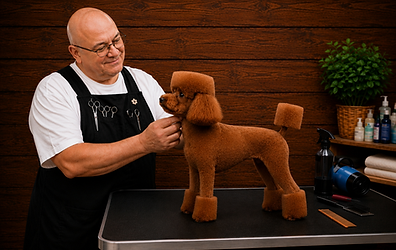
Toy Poodle Trump Style Asian Cut


Elegant Asian Cut for Toy Poodle


Asian Grooming Style “Fluffy Love” 🐩✂


How a haircut can completely change a dog
Grooming is an optical illusion


What determines the way your Toy Poodle looks?
Genetics? Yes, of course.
Nutrition? Absolutely. That matters too.
Care? And this is where things start getting interesting.
Because… what do most people usually mean by “care”?
Bathing the dog, brushing the coat, trimming the ends a little. Teeth, nails, ears, eyes… everything clean, everything neat. Perfect. 😄
But there is a big difference between simply “cutting the hair”… and grooming.
Today, grooming is practically an entire universe of styles, techniques, visual effects, new trends, and transformations that sometimes look almost like magic.
And honestly… keeping up with all the new ideas takes far more than just one afternoon.
I have prepared a lot of interesting things for you about Toy Poodle grooming.
See those buttons?
Go ahead. Click them… and prepare to be amazed. 😄