

Traveling with a Toy Poodle: how to travel with your dog without stress
Traveling with a Toy Poodle can be a wonderful experience if properly prepared. Before setting off, it’s important to understand the health requirements,
choose the right mode of transport, and follow the rules of each carrier.
With good preparation, traveling with your dog can become an enjoyable
adventure for both the pet and the whole family.
Toy Poodles usually adapt very well to travel. They are intelligent, sociable, and strongly attached to their owners, so they generally prefer to go along with their family rather than stay home alone.


Documentation required for traveling with a dog
Before traveling with your Toy Poodle, make sure they have all the necessary documentation.
You will usually need:
-Identification microchip
-Valid rabies vaccination
-European pet passport if traveling within Europe
-Veterinary certificates in some countries
If you are planning to travel abroad, it’s important to check the specific requirements of your destination country, as they may vary.
European countries with special requirements for traveling with dogs
In most European countries, it is enough for a dog to have a microchip, a valid rabies vaccination, and a European pet passport.
However, some countries have additional rules that you should be aware of before traveling.
Finland
Also requires antiparasitic treatment against tapeworm before entering the country.
Malta
In addition to the tapeworm treatment, veterinary authorities may carry out additional checks upon arrival at the airport in some cases.
Norway
Norway has strict health regulations and also requires antiparasitic treatment before entry.
United Kingdom
After Brexit, the United Kingdom no longer accepts the European pet passport directly. In many cases, an Animal Health Certificate issued by a veterinarian is required before travel, in addition to tapeworm treatment.

Requirements for traveling with a dog in Europe
Country Main requirements Notes
Spain Microchip + rabies vaccination European pet passport
France Microchip + rabies vaccination Some breeds are restricted
Germany Microchip + rabies vaccination Regulations for breeds considered dangerous
Italy Microchip + rabies vaccination Travel with a carrier required on trains
Portugal Microchip + rabies vaccination European pet passport required
Netherlands Microchip + rabies vaccination Strict animal welfare regulations
Belgium Microchip + rabies vaccination Up-to-date veterinary documentation
Switzerland Microchip + rabies vaccination Non-EU country with similar rules
Norway Microchip + rabies vaccination + antiparasitic treatment Mandatory tapeworm treatment
Finland Microchip + rabies vaccination + antiparasitic treatment Tapeworm treatment required before entry
Ireland Microchip + rabies vaccination + antiparasitic treatment Veterinary check on arrival
Malta Microchip + rabies vaccination + antiparasitic treatment Strict health regulations
United Kingdom Microchip + rabies vaccination + veterinary certificate Animal Health Certificate required after Brexit
Traveling with a dog to Asia
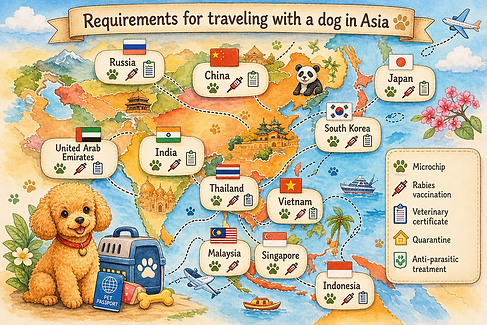
Traveling with a dog within Europe is usually relatively simple: a microchip, rabies vaccination, and a European pet passport are enough. However, when it comes to traveling to Asia, things can become much more complex.
Many Asian countries have very strict health regulations, mandatory quarantine periods, or administrative procedures that must be prepared weeks or even months in advance. If these requirements are not understood in time, the trip can become a stressful experience for both the dog and its family.
For example, Japan requires preparation that can begin up to 180 days before travel, including rabies serology tests carried out in approved laboratories. In Singapore or Hong Kong, health controls are also very strict, and documentation must be submitted with precision.
In other Southeast Asian countries, such as Thailand or Indonesia, import permits issued by local authorities may be required in addition to veterinary certificates.
This does not mean that traveling with a dog to Asia is impossible. It simply requires planning, information, and patience. With proper preparation, the trip can be completely safe and enjoyable.
In the map and table below, you can see an overview of which Asian countries have stricter requirements for traveling with dogs.

Traveling with a dog to America
Traveling with a dog across the American continent can be a wonderful experience, but it can also turn into an unpleasant surprise if you are not familiar with the rules of the destination country.
Unlike Europe, where many countries share similar regulations, in the Americas each country has its own health requirements, certificates, and veterinary controls. In some cases the process is simple, but in others it may involve quarantine, special permits, or documentation that must be prepared weeks in advance.
If the trip is for vacation, it’s important to get well informed before departure. Otherwise, an uncomfortable situation may arise: while the family enjoys the beach or the city, the dog spends the holiday in a veterinary quarantine facility.
For example, some countries in the Caribbean and South America may require specific veterinary certificates and health checks upon arrival. In other cases, such as on certain islands, animals may remain under observation for several days or even weeks.
In the United States or Canada, the process is usually simpler, but it is still mandatory to meet requirements such as a microchip, rabies vaccination, and valid veterinary documentation. In addition, airlines may have their own rules regarding pet transport.
This does not mean that traveling with a dog across the Americas is difficult. It simply requires good preparation, timely documentation, and an understanding of each country’s regulations.
In the following map, you can see an overview of which countries in the Americas have stricter requirements for traveling with dogs.


Countries where traveling with a dog is more difficult around the world


Dog carrier for travel: how to choose without making mistakes
Choosing the right carrier is not just a formality — it can determine whether your trip with your Toy Poodle is comfortable… or a real source of stress.
The first thing you need to know: each airline has its own rules, and they don’t always match. That’s why you should never buy a carrier “blindly” — always check the airline’s requirements first.

You may also be interested in:
Traveling with a dog by plane may seem simple… until you arrive at the airport and are told that your dog cannot fly.
It doesn’t matter that you have everything prepared: the right carrier, tickets, documents, vaccinations.
There are cases where, even when all the rules are met, the airline may refuse
the animal at the last moment.
And there is a group of dogs for which the risk is much higher.
Some breeds have very strict restrictions:
👉 they are not allowed to travel in the cargo hold
👉 they have limitations even in the cabin
👉 and some airlines do not accept them at all under any circumstances
Many owners find this out too late.
👉 We are talking about brachycephalic dogs.
Before planning your trip, watch this video: it includes the full list according to IATA regulations and airline policies.
It could save you from a very serious problem.
IATA carrier: choosing the right size
Choosing the right carrier is not just a matter of comfort — it is a mandatory requirement to travel with your dog by plane.
Many people think that “a crate the size of the dog” is enough, but in reality airlines follow international (IATA) standards, and if the carrier does not meet them, the animal may not be accepted on the flight.
One of the most common mistakes is choosing a carrier that is too small.
The dog must be able to:
👉stand up without touching the top
👉turn around easily
👉lie down comfortably
If these conditions are not met, the airline may refuse transport, even at the airport.
In the following table, you can see the standard IATA carrier sizes and the type of dog they are intended for.

💡 For a Toy Poodle, the most commonly used sizes are IATA 100 (and in some cases 200 if more space is needed).
❌ Carrier too small
“The dog fits, it’s fine”
👉 No.
If the dog cannot stand up or turn around comfortably,
it may be rejected at the airport.
❌ Incorrect dimensions (even if it “almost fits”)
Missing 2–3 cm… seems like nothing.
👉 For the airline, it isn’t.
It can be enough to deny boarding.
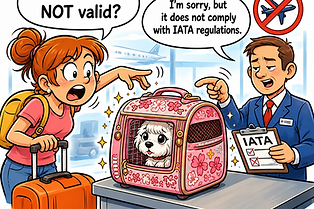
❌ Non-approved carrier (IATA)
Nice, comfortable… but not valid.
👉 Without proper ventilation or secure locking
= no flight
❌ Booking without informing that you’re traveling with a dog
Many airlines have a limit on the number of animals per flight.
👉 Result:
your dog has no spot, even if you do
❌ Not checking airline restrictions
Each airline has its own rules.
👉 What works for one
may not work for another
❌ Traveling in extreme heat or cold
Some airlines cancel transport in the cargo hold for safety reasons.
👉 And this can happen
on the same day of the flight
💡 Important tip
Traveling with a dog is not difficult…
but it’s not something to improvise either.
A small detail can make the difference between:
✈️ a smooth trip
or
🚫 staying on the ground



⚠️Important!
Transport rules, requirements and airline policies may change over time and can vary depending on the airline or destination country.
Before traveling, we recommend always confirming the information directly with the airline and the corresponding official authorities.