

Toy Poodle Character
Inside the Toy Poodle
Why some people have dogs… and others end up having poodles.
Why Do Some People Become “Poodle People”? 🐩
There is an old joke that says a poodle has already stopped being a dog, but has not quite managed to become a person yet.
And honestly, after many years of living with them, I am beginning to understand exactly where that saying comes from. 😄
I am not going to tell you that the Toy Poodle is a perfect dog.
First, because perfect dogs do not exist.
And second, let's be honest: this is my favorite breed, so expecting
complete objectivity from me would be a little naive. 😄
But there is one interesting fact. For about twenty years, the poodle remained
one of the most popular breeds in the United States.
Then came new fashionable breeds, designer dogs, and the latest canine trends.
It seemed as if the story was over.
But it wasn't.
Today the poodle is making a strong comeback.
And it is not because people suddenly remembered old dog show photographs.

Simply more and more people are discovering that behind that beautiful coat there is a very special personality.
The Toy Poodle really is different from most small breeds. Not always better. Not always easier. But definitely different.
That is why I am not going to try to convince you that it is the best dog in the world.
I am simply going to try to show what a Toy Poodle is really like in everyday life. Without advertising slogans. Without the usual phrases about intelligence and loyalty. Just point by point.
Because it is precisely through those little details that many people eventually find themselves thinking one day:
“I think I've become a poodle person.” 😄
The Toy Poodle and Rules.
Many breeds learn commands. A Toy Poodle usually tries to understand the system. The difference seems small. In reality, it is enormous. If you say: — You're not allowed on the sofa. Most dogs will simply learn: sofa = forbidden.
The poodle usually accepts that too. In fact, very often it seems to have understood perfectly the very first time.
But after a while, something curious starts to happen.
For example, one day you have a headache. You lie down on the sofa.
A few minutes later, a concerned poodle appears to check whether you're still alive.
Because now we're no longer talking about a sofa.
We're talking about a humanitarian mission. 😄
You simply can't abandon a human being in such a situation.
Another day, you bathe the dog. You wrap it in a towel.
And, so it doesn't get cold, you let it sit on the sofa for a moment.
The poodle carefully files away this new information. Interesting.
Apparently, special circumstances exist.
Later, guests arrive. And someone invites the dog onto the sofa.
Another exception appears. Over time, the simple rule:
"You're not allowed on the sofa" begins to turn into a rather complex document.
With appendices. Footnotes.
And several legally questionable interpretations. 😄
The funny thing is that many poodles do not see rules as absolute laws.
They see them as study material.
They rarely challenge a rule directly. They rarely rebel.
But they are extraordinarily good at finding exceptions.
And the most unsettling part is that, very often, those exceptions seem perfectly reasonable. Because technically... the poodle is usually right. 😄
Perhaps that's why so many people consider the Toy Poodle an exceptionally intelligent breed. Not just because it learns quickly. Not just because it memorizes commands.
But because it constantly gives the impression that it isn't only thinking about what is happening. It's trying to understand why it is happening.
And for such a small head, that's surprisingly impressive. 🐩


The Toy Poodle and Situation Control.
Some dogs live alongside people.
The Toy Poodle prefers to work as its human's personal manager.
It needs to know: where you're going, why you're going, how long you'll be gone,
and why you've opened the refrigerator again.
Curiously, that last question is usually the one that interests it the most.
Many owners eventually notice something strange.
The poodle seems to know exactly when its person is arriving home.
Not the neighbour. Not the delivery driver. Not just any car passing by. You.
And very often it knows before you've even opened the door.
Some poodles start getting excited while their owner is still on the way home.
How do they do it? The sound of the car? Footsteps? Scent?
Or some ancient form of canine magic reserved exclusively for poodles?
I don't have a definitive answer.
But there's another interesting observation.
Before you had a poodle, you could move around the house peacefully and alone.
After getting a poodle, that usually comes to an end.
Because now you have a shadow. A small one. A fluffy one.
And an extraordinarily curious one. You go to the kitchen — the shadow goes to the kitchen.
You go to the bedroom — the shadow goes to the bedroom.
You go to the bathroom — the shadow considers it necessary to discreetly supervise the situation.
Not because it's afraid of being left alone.
Most of the time it simply needs to know what's going on.
And, if possible, take part in it.
Sometimes it feels as though many Toy Poodles are genuinely convinced of one thing:
that the stability of the universe depends, at least to some extent, on their presence.
And that if a human is left unsupervised for too long, sooner or later something will go wrong.
That's why they accompany you.
They observe. They check.
And they maintain the family's cosmic balance with admirable dedication.
At least from their point of view.


The Toy Poodle and the Talent for Enjoying Life.
There are more serious dogs. More independent dogs. Philosopher dogs.
And there are also dogs that seem suspicious of absolutely everything.
The Toy Poodle usually belongs to a different category.
It is genuinely convinced that life is, on the whole, a pretty good idea. 😄
Woken up? Perfect.
Has its favourite person woken up too? Even better.
Time for a walk? Wonderful.
Not time for a walk, but someone has opened the refrigerator?Well, that's not bad either.
Many poodles are surprisingly optimistic.
They enjoy being involved in what's happening. They like being nearby.
They like observing. They like being part of the action.
Sometimes it feels as though they begin each day firmly convinced that something good is about to happen.
And they wait for that event with genuine enthusiasm.
Perhaps that's why poodles are so expressive.
When they're happy, you can tell. When they're surprised, you can tell.
When they're offended... you can definitely tell. 😄
And sometimes it seems that emotions aren't reflected only on their face.
The entire poodle gets involved. From the tip of the nose to the tip of the tail.
There is another curious trait.
Many poodles seem to know perfectly well when they look especially good.
For example, after a grooming session.
During the bath, drying and brushing, they may behave in a thousand different ways.
But when it's all over and they leave the grooming salon...
sometimes you get the feeling that they know exactly how the final result turned out.
Their walk becomes slightly more important. Their expression becomes a little more confident. And somewhere inside that small head, a very simple thought seems to appear:
"Yes. I really do look magnificent." 😄
And perhaps that's why so many people smile more when they live with a poodle.
Because it's difficult to stay serious around an animal
that is convinced the world is full of good people,
interesting things and reasons to be happy.
And the best part is that very often they manage to convince you as well.


The Toy Poodle and Other Animals.
There is a curious trait found in many Toy Poodles. They seem genuinely convinced that the world is full of good intentions.
Many breeds observe first. They are a little cautious. They analyse the situation. And only then decide whether it's worth approaching.
The poodle usually starts from a different point. Its reasoning tends to be more like: "Something new. How interesting. Let's see if we can be friends." And that has its advantages. But it also has a few drawbacks.
Because many poodles seem to lack the natural suspicion that other breeds often show when something unfamiliar appears. They don't expect trouble. They don't expect aggression.
They don't expect bad intentions. And precisely because of that, sometimes the owner has to be more cautious than the dog itself.
I learned this in a rather hard way during the COVID period.
One day I was walking several small poodles in a park.
Suddenly, a seagull appeared. At that time, seagulls had become especially bold
in their search for food.
And one of them tried to carry off one of the puppies. The most surprising thing was not the seagull. It was the mother's reaction.
Until the very last moment, she seemed convinced that it was some kind of game.
As if that enormous bird had appeared to interact with the puppy rather than harm it.
Fortunately, we managed to get the little one back. He survived.
But that day gave me a lot to think about.
Sometimes poodles trust the world so much that they need us to provide the common sense on their behalf.
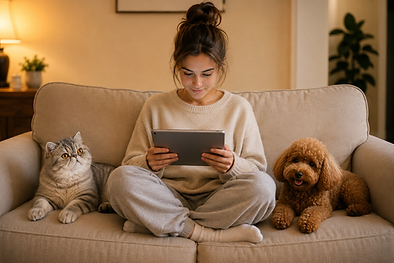
The same often happens with cats.
If the cat wants to play, perfect.
If the cat doesn't want to play, that's fine too.
Most poodles simply accept the situation and continue with their own business.
They do not feel a particular need to prove who's in charge.
With birds, they usually become curious. They enjoy watching them.
Following their movements. Trying to understand what they're doing.
But very often, curiosity is stronger than the instinct to chase.
And then there are other dogs. Here it's worth being a little more careful.
Not because the Toy Poodle is aggressive.
But because, for its size, it is often surprisingly brave.
Sometimes even a little too brave. 😄
Many poodles seem convinced that size is a completely irrelevant detail.
And because of that, they are not always aware that the dog standing in front of them weighs ten times as much as they do. I even have a video in which a tiny teacup poodle steals a pine cone from an English Bulldog and flatly refuses to give it back. The Bulldog looks at the poodle. The poodle looks at the Bulldog. And the little one is completely convinced that the negotiation is proceeding exactly as she had planned. 😄
Perhaps that's why poodles usually get along well with so many different animals. Not because they see the world as a dangerous place.
But precisely because they start from the opposite assumption. And they expect to find friends long before they expect to find enemies.
The Toy Poodle and Its Curious Sense of Dignity.
Perhaps this is one of the reasons why so many Toy Poodles seem so brave. They rarely seek conflict. But they rarely assume they are going to lose one, either. There is an important difference. Many small breeds develop a certain distrust of the world. The poodle, on the other hand, usually starts from a much more optimistic assumption: "Everything will be fine."
And, surprisingly, it spends most of its life behaving as though it genuinely believes that.
Of course, there are also more cautious poodles. As with any breed.
But very often, it is not a matter of fear.
They are usually calm dogs that one day reached a rather logical conclusion:
"Safety is the human's responsibility."
Sometimes you can even guess when it happened. Something frightened the puppy.
The owner protected it. And the poodle took note.
From that moment on, it became clear who was responsible for dealing with important problems.
And the poodle stopped worrying too much about them.

Even the smallest poodles, however, tend to possess a remarkably
strong sense of self-confidence.
Sometimes they seem genuinely convinced that, if necessary,
they could protect the entire family.
Even if they weigh only two kilograms.
Even if the danger weighs forty times more.
And even if the entire plan has not been thoroughly thought through.

They also have a curious ability to feel offended.
Not necessarily frightened.
Offended.
For example, some poodles are capable of remembering for years a broom that accidentally hit them one day.
Not because they are afraid of it.
But because they consider it to have been a completely unnecessary lack of respect.

And then there is another detail that many owners eventually notice: cleanliness. Over the years, I have known a great many poodles that were surprisingly clean. So many, in fact, that one eventually starts wondering whether it is simply hygiene...or personal dignity. 😄
I remember a dog show. In one corner, an area with sand had been prepared for the dogs to relieve themselves.
As a responsible owner, I took Madonna there. She examined the place. Looked at the sand.
Looked at the other dogs.
Looked at the sand again. Took two steps. Stopped. And then looked at me with an expression that I can still remember perfectly to this day. A rough translation would be something like:
"Am I correct in understanding that you expect me to use THIS place?" 😄
She looked at the ground. She looked at me. She looked back at the ground.
And she seemed genuinely horrified by the entire situation.
Eventually, I took out a training pad. I placed it beside her. And a small miracle occurred.
Madonna practically launched herself onto the pad with indescribable relief, did what she needed to do, and then remained standing on the edge, looking at me with an expression that was perfectly clear:
"Excellent. Now please take me away from here as quickly as possible." 😄
The other owners were laughing out loud. And Madonna seemed perfectly aware that she had an audience.
Which, to be honest, probably didn't bother her in the slightest. 😄

After living with poodles for many years, you begin to suspect something rather curious. Perhaps they do not consider themselves kings.
Perhaps they do not even consider themselves the centre of the universe. But sometimes, looking at their posture, their expression, and the way they observe the world... it becomes difficult to avoid the feeling that they may have a slightly different opinion on the matter. 🐩😄
The Toy Poodle and Its Favourite Person.
Many people believe that dogs choose the person who gives them the most treats.
Or the one who shares the most food. Or the one who allows the most indulgences.
With poodles, reality is usually a bit more complicated.
Because one of the most surprising things about this breed is how quickly they seem to understand how a family works. They arrive in a new home. They observe. They listen. They analyse. And somehow, they begin drawing conclusions.
Who made the decision to bring the dog home. Who solves the important problems.
Who makes the final decisions. Who provides a sense of security.
And who can protest all they like but, in reality, does not decide very much.
The most curious part is that sometimes the poodle seems to understand these family dynamics before some family members do. And once it has reached its conclusions...
it rarely changes its mind. Of course, it usually loves the whole family.
It plays with everyone. Accepts affection from everyone. And enjoys everyone's company.
But very often there is one person who occupies a special place.
It is not always the person who feeds it. Not always the person who spends the most time with it. And not always the person who spoils it the most. It is simply its person.
And once that decision has been made, something interesting happens.

The rest of the family has an affectionate poodle. That person has a poodle of their own. 😄
Many owners discover something else as well. Unlike some other breeds, poodles rarely seem to make important decisions based solely on food. They enjoy treats. Of course.
But they usually value the relationship far more than whatever happens to be in your pocket.
A piece of cheese will always be appreciated. But that is rarely enough to buy their loyalty.
And then that very characteristic behaviour appears.
The poodle starts following its favourite person all around the house.
Not necessarily because it is afraid of being left alone. Nor because it is overly dependent.
It simply seems to believe that both of them should be more or less in the same place.
Just in case. For the sake of organisational efficiency. 😄
It is that person it waits for by the door.
It is that person's arrival that it usually detects before anyone else.
It is that person's mood that it seems to sense with particular ease.
Sometimes it feels as though the poodle watches its favourite human with the attention of a professional bodyguard. Only much smaller. And considerably more adorable. 😄
Perhaps that is why so many people develop such a special relationship with this breed.
Because behind all that intelligence, all that self-confidence and all those little eccentricities...
there is usually an enormous loyalty. Quiet. Constant.
And surprisingly deep for such a small dog. 🐩❤️

The Toy Poodle and People.
One of the most curious things about the Toy Poodle is that it seems to understand quite well who it is dealing with. With children, it tends to behave one way.
With older people, another. With active adults, yet another.
And very often it adapts its behaviour better than one might expect from such
a small dog. Perhaps because, deep down, poodles enjoy companionship more than the activity itself. A child wants to play. Perfect.
A teenager wants to run. Perfect.
An older person wants to sit quietly and have a coffee.
Perfect as well. What matters is not always what is being done.
What matters is taking part.
However, where this ability becomes most interesting is with strangers.
Most Toy Poodles tend to be quite sociable.
They enjoy meeting new people. They enjoy visitors. They enjoy receiving attention.

But very often, before deciding what they think about someone,
they carry out a small check. They look at their favourite person.
And wait for their opinion.
Sometimes it seems that the poodle's first thought is:
"There's a new person. Do we approve?" 😄
If the answer is positive, everything is usually quite simple.
But if something doesn't feel right to them... the situation changes.
Many poodles move closer to their owner.
They seek contact. They observe from nearby.
And they prefer to wait before making a decision.
Over the years, I have come to suspect something rather curious.
Poodles pay a great deal of attention to the emotions of the people they love.
Far more than we usually imagine.
That is why, if you happen to dislike someone, it can be surprisingly difficult
to convince a poodle that everything is perfectly fine.
You can smile. You can be polite. You can try to appear calm.
But the poodle keeps watching. Because it seems to pay less attention to words and more attention to everything else. To the tone of voice. To gestures. To tension.
To those small details that often go unnoticed by other people.
And when it notices that something doesn't quite fit, it usually trusts its own conclusions more than our explanations. Perhaps that is why so many owners end up feeling that they live with a dog. And, at the same time, with a small specialist in human relationships who was never officially hired for the position.

And speaking of human relationships... There is another concept that many poodles understand perfectly well in theory.
Personal space. The Toy Poodle usually respects your personal space. Provided, of course, that there is also room within that personal space for a poodle. Because, after all, it is rather difficult to supervise a person's emotional well-being from another room.
And besides... who knows what important decisions you might make without first consulting
the Department of Poodle Affairs? 😄
How to Know If You've Become a Poodle Person?
After everything we've discussed, perhaps it's time to find out. 😄 Let's look at a few signs.
- You talk to your poodle more than you ever planned to.
- You explain where you're going before leaving the house.
- You greet your poodle when you return as if you hadn't seen each other for weeks.
- You are convinced that your poodle understands far more than it lets on.
- You have taken more photos of your poodle this year than of some members of your family. 😄
- You opened your phone gallery to show someone a photo and discovered that the last thirty pictures were also of your poodle.
- You have said: "I'll just show you one photo." And ten minutes later you were still showing poodle photos.
- You have entire conversations with your poodle and, most worryingly, sometimes you're convinced those conversations were quite productive.
- You ask your poodle to move out of the way. It doesn't move. And somehow you're the one who ends up changing direction. 😄
- You have bought something for your poodle and then thought: "I wouldn't even buy this for myself."
- You have cancelled plans because the poodle was sleeping too comfortably on top of you.
- When you travel, your phone fills up with photos and videos sent by the person looking after your poodle.
And you watch every single one of them. 😄
- You buy a new bed for your poodle. And it ends up sleeping exactly where it wanted to sleep in the first place.
- You're reading this list and are slightly annoyed by how accurate it is. 😄
- You started this page thinking you were going to read about dogs. And you're finishing it thinking about your poodle.
If you recognised yourself in one or two points, there is still time. 😄
If you recognised yourself in five or six... I'm afraid the process is already well advanced.
And if throughout this entire page you kept thinking: "Yes. That's exactly what my poodle is like."
Congratulations.
You are officially a poodle person. 🐩❤️
And right now your poodle is probably reading this over your shoulder
and wondering why it took you so long to realise it. 😄
