


FCI Poodle Standard
2024 Changes
and Clear Explanation
The Poodle standard is no longer the same.
For years, the breed was defined by very strict rules, especially regarding colors and presentation. However, the new FCI standard introduces important changes that not everyone knows or fully understands.
Are new colors now allowed? Have the evaluation criteria changed?
What is still considered a serious fault or a disqualification?
On this page, we show you the before and after of the Poodle standard,
with a clear and professional explanation based on a real interpretation of the official document.
We will go through it page by page and explain exactly what has changed.

FCI 2007 FCI 2024 What has changed
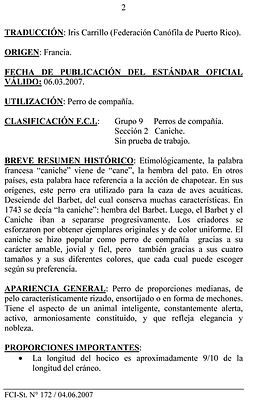

Before: One translator (Puerto Rico)
Now: Two translators
This is not just a formality; it indicates a revision
of the document.
In the updated standard, new body proportions have been added to better define the poodle’s structure.
Now, not only the relationship between the muzzle and the skull is considered, but also the overall balance of the body, such as the length of the dog in relation to its height.
This allows for a more precise evaluation and avoids subjective interpretations.


The current standard defines body proportions more precisely, allowing the poodle to be evaluated more objectively rather than just visually.
In the 2024 standard, greater importance is given to the dog’s temperament, emphasizing its character over mere behavior.
The new standard aims for a more balanced and elegant head, avoiding extremes such as overly heavy or exaggerated heads.
The stop (naso-frontal depression) should be discreet, but it must not disappear. This helps maintain the typical poodle expression.
The 2024 standard adapts nose pigmentation to the new range of recognized colors, including bicolor and tricolor poodles.


The current standard requires complete and strong dentition, indicating greater attention to the dog’s health and functionality.
In the new standard, the importance of pigmentation is reinforced, especially in light-colored dogs, where the eye rims should be as dark as possible.
The current standard favors slightly longer ears, ideally extending beyond the corner of the lips, enhancing the poodle’s elegant expression.
👉 Notice that the wording has become:
— more precise
— stricter
— less vague


The current standard describes the body in a more structured way, separating each part for a clearer and more precise evaluation.
The concept of the topline is introduced, assessing the harmony and firmness of the back as a whole.
The standard now evaluates the entire underline of the body, not just the abdomen, providing a more complete view of the structure.
The current standard prohibits tail docking, aligning with modern animal welfare regulations.
A general evaluation of the limbs is added, assessing them as a whole rather than only each part separately.


The current standard requires stronger pigmentation in the nails and extremities, especially in light-colored dogs.
A general evaluation of the hind limbs is added, assessing them as a whole rather than each part individually.
The current standard describes the hind feet separately, allowing for a more precise evaluation of the structure.
The structure of the standard has been reorganized, clearly separating the coat description into an independent section.


👉 NEW ALLOWED COLORS
The new FCI standard introduces significant changes in Poodle colors, expanding the possibilities and better defining quality criteria.
Bicolor (parti) colors are now officially recognized, such as black and white or gray and white.
In bicolor poodles, white must be the predominant color.
Any white markings in solid colors are considered highly undesirable.
The gray color may show variations depending on age.
Fawn is accepted within a wider range of shades.
These changes reflect an evolution of the standard toward greater precision and adaptation to the genetic reality of the breed.


New Color Patterns in the Poodle (FCI 2024)
The updated standard introduces, for the first time, a detailed description of multiple colors in the Poodle, including bicolor, tricolor, and other multi-colored patterns.
Patterns such as “tuxedo,” with white markings in specific areas, are recognized.
Fawn markings and their placement on the body are precisely described.
Tricolor patterns (black, white, and fawn) are included.
New colors such as brindle are added.
Despite this expansion, the standard maintains a clear preference for solid and uniform colors.


Changes in Poodle Evaluation (New FCI Standard)
The updated standard introduces a more modern approach to breed evaluation, focused on the dog’s health, welfare, and functionality.
A clearly visible sexual dimorphism is required.
Faults are assessed according to their impact on health and well-being.
Rigid criteria for automatic disqualification are removed.
Strict size limits are relaxed.
Morphological evaluation is simplified, allowing more room for expert judgment.
Final Changes in the Poodle Standard (FCI 2024)
The updated standard introduces a more modern and balanced view of the breed, where aesthetics are combined with functionality and health.
Color harmony and the distribution of markings are evaluated.
Concepts such as “mis-marking” and “pirate markings” are introduced.
The importance of health and functionality in breeding is reinforced.
Excessive grooming in shows is limited.
Authorized clips are described in detail.
The goal is a fairer evaluation, where the dog’s true quality takes priority over its aesthetic presentation.
Here I attach the remaining pages of the new standard, as it is longer than the previous one.


