

👁️ Toy Poodle Eyes and Tear Stains
First, let’s understand how the tear system works.
Then we’ll look at what to do about it.
Before cleaning, drying, or looking for miracle products, it helps to understand how the tear system works. Once we know the cause, eye care becomes much simpler.
👁️ How Does the Tear System Work?
Your Toy Poodle's eyes produce tears constantly. Not because they're sad. Not because they've just seen the price of dog food. 😄
Tears have a very important job: ✔ to keep the eye moist, ✔ to clean it, ✔ to protect it.
After flowing across the surface of the eye, the tears normally disappear through tiny tear ducts located in the inner corner of the eye.
And this is where problems can begin.
If too few tears are produced, the eye becomes dry and may become irritated or inflamed.
If too many tears are produced, a small cosmetic drama appears: the famous tear stains.
And if the tear ducts become narrowed or blocked, the tears simply find another route... usually running down the dog's face.
In the Toy Poodle, this can happen quite easily because the muzzle is small and the tear ducts are small as well.
That is why, in some cases, a simple blockage can become a lifelong problem. There are procedures that may help reopen blocked tear ducts, but in such tiny dogs they are not always simple and they are not without risks.
👉 That is why it is far better to keep the tear system working properly than to try to repair it later.


Why Do Tear Stains Appear?
Imagine that your Toy Poodle has a tiny but very sophisticated plumbing system built in. 😄
This system produces tears, spreads them across the eye to clean and protect it, and when their job is done, sends them into a small drain located in the inner corner of the eye.
Today we're not going to talk about what happens when there are too few tears.
We're going to talk about what happens when there are too many.
Why does this happen?
🔹 hard tap water,🔹 teething and tooth replacement,
🔹 hair irritating the eye,🔹 smoke or household cleaning products,
🔹 stress, wind, or changes in environment,🔹 an unsuitable diet.
If the cause lasts only a short time, there is usually nothing to worry about.
The tear system is simply doing its job: protecting the eye.
But if the irritation continues, the body receives a very simple message:
👉 “We need more tears.”So it produces more. And more. And more.
Over time, it may start treating that excess tear production as normal.

There is another problem as well. If we do not regularly clean the inner corner of the eye, tiny particles of dried tears can gradually find their way into the tear ducts. Over time, these small deposits may interfere with the normal drainage of tears and make the problem worse.
Think about a kitchen sink. When it starts to clog a little, acting early is often enough to get the water flowing normally again.
But when the blockage becomes serious, it is time to call a plumber.
Tear ducts work in much the same way. That is why, when your dog starts producing more tears than usual, the goal should not be to fight the brown stain. The goal should be to find the cause.
👉 Check the inner corner of the eye. Keep the area clean Gently massage the muzzle from the eye toward the nose.
During bath time, allow clean, lukewarm water to flow gently over the eyes.
You could think of it as the canine equivalent of a tiny drain cleaner. 😄
Sometimes we get lucky, clear a partial blockage, and the tear system returns to normal.
On the other hand, if we focus only on removing the brown stain without addressing the cause, we may end up fighting that stain for the rest of the dog's life.

How to Care for a Toy Poodle's Eyes
If we had to summarize all eye care in a single sentence, it would be this:
👉 Don't fight the stain. Help the tear system function properly.
🟢 1. Keep Hair Away from the Eyes
The Toy Poodle has one special characteristic: its hair never stops growing.
And this raises an interesting question:
👉 Why do you think poodles had their faces shaved for more than a century?
It wasn't just for appearance.
The tear ducts are very small, and hair can become a constant source of irritation. In some dogs, eyelashes or hairs near the eye may even change direction and rub against the cornea.
The body's response is simple:
👉 more irritation = more tears.
That is why keeping the area around the eyes clear remains one of the most effective preventive measures.
🔵 2. Clean the Inner Corner of the Eye Regularly
Most owners focus their attention on the brown stain.
However, the truly important area is the inner corner of the eye.
This is where the entrance to the tear duct is located.
If dried tear residue is allowed to accumulate, tiny particles can eventually enter the duct and interfere with the normal drainage of tears.
That is why it is better to do a little cleaning every day than to deal with a much bigger problem later on.
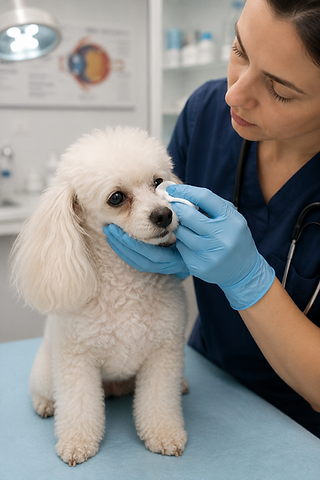
🟣 3. A Little Massage Can Help
Imagine that beneath the skin there is a microscopic drainage pipe responsible for carrying tears away from the eye.
A gentle massage from the inner corner of the eye toward the nose may help move tiny particles that have accumulated near the tear duct.
There is no need to press hard.
There is no need to overdo it.
Just gentle movements following the natural direction of tear drainage.
And one more useful tip:
👉 Avoid walking your dog in strong winds whenever possible.
Dust, sand, and other tiny particles can enter the eyes and, in some cases, irritate or even damage the delicate tear ducts.

🚿 4. The Simplest "Drain Cleaner"
During bath time, allow a little clean, lukewarm water
to flow gently over the eyes.
No soap.
No shampoo.
No special products.
Sometimes this simple rinse helps remove tiny particles that have
accumulated near the entrance of the tear ducts.
It's not magic.
But you could think of it as the canine equivalent of using a small
drain cleaner before calling the plumber. 😄
🔶 5. When the Problem Is Already Inside the Tear Duct
Tear ducts can also be cleaned through a veterinary procedure known as tear duct flushing or probing.
The veterinarian inserts a very fine probe into the duct and flushes it in an attempt to remove the blockage.
However, in tiny dogs such as the Toy Poodle, these ducts are extremely delicate.
For that reason, not every veterinarian performs this procedure, and there is always a risk of damaging the duct if the procedure becomes difficult.👉 In other words, it is always better to keep the tear system working properly than to try to repair it once it has already become blocked.
Why Is the Tear Stain Brown?
Because tears contain small amounts of minerals, including iron.
When tears remain on the hair for long periods of time, these compounds react with the air and oxidize, creating the characteristic reddish-brown stains that we often see beneath the eyes of light-colored dogs.
That is why, in many cases, the stain itself is not the real problem.
The stain is simply a message from the tear system telling us that something is not working quite as it should. 😉


.
🤔 Why Shouldn't We Focus Only on the Stain?
Imagine a leaking pipe.
You can wipe the floor every day and the kitchen will continue to look clean.
But the leak will still be there.
Tear stains work in exactly the same way.
If too many tears are being produced, the stain is not the problem.
The stain is simply the result.
That is why, before thinking about cosmetics, it is worth finding out:
🔹 why the eye is producing more tears,
🔹 whether the tear ducts are functioning properly,
🔹 whether hair is irritating the eye,
🔹 whether any inflammation is present.
Only after that does it make sense to think about cosmetic products.
Why Do Tear Stains Appear?
First, some good news.
The brown stain beneath the eye is not dirt.
And it does not necessarily mean that the dog is poorly cared for.
In reality, it is simply a tear that has remained on the hair for too long. 😄
Tears are not made of water alone.
They contain salts, proteins, minerals, and other substances that help protect the eye.
When tears continually wet the hair, the water evaporates but the remaining components stay behind.
Over time, some of these substances oxidize when exposed to air, and the hair begins to develop a reddish or brownish discoloration.
The lighter the dog's coat, the more noticeable this effect becomes.


Do Tear Stain Products Work?
Yes. And no. 😄
Most of these products can make the stain less noticeable.
Some lighten the hair.
Some remove already stained hair.
Others try to prevent new stains from appearing.
But none of them can change the laws of physics.
If tears continue to run over the hair every day, the stain will eventually return.
That is why, in our kennel, we usually start with something much simpler:
👉 trimming or shaving the stained hair around the inner corner of the eye.
The logic is simple.
That hair is already stained.
We can spend weeks trying to lighten it...
or remove it and wait for new hair to grow.
And new hair usually appears much sooner
than an old stain disappears. 😄
After that, it is a good idea to keep the area clean for a few days
and reduce any possible irritation.
Only when new hair starts to grow does it make sense to use cosmetic products
to help keep it clean and prevent new stains from forming.
Because, honestly, whitening already stained hair is usually much more difficult
than preventing new hair from becoming stained in the first place.

A Little Secret from Breeders
The most beautiful eyes on a Toy Poodle usually do not belong to the dog that uses the most whitening products.
They usually belong to the dog whose tear system is working properly. That is why experienced breeders rarely look at the brown stain first. They look at the inner corner of the eye. They look at the amount of tears being produced.
And they look at the condition of the tear ducts.
Because removing a stain is much easier than correcting the cause that created it.
After all, the brown stain is not the problem. It is simply its signature.
❓ Frequently asked questions about Toy Poodle eyes
🔹 Is it normal for my Toy Poodle to have tears?
Yes, in many cases it’s normal. Mild tearing can be related to teething, hair, or eye sensitivity.
👉 But if it is constant or leaves stains — the cause should be checked.
🔹 How do you remove tear stains in a Toy Poodle?
They cannot be removed by cleaning alone. First, you need to correct the cause: ✔️ diet, ✔️ water, ✔️ irritation (hair, environment).
Then — proper daily cleaning. 👉 Without this, the stains will always come back.
🔹 How often should you clean the eyes?
It depends on the dog: No tearing → no cleaning needed. With tearing → daily.💡 Cleaning “just in case” is not recommended.
🔹 What product should be used to clean the eyes?
Ideally: ✔️ a specific eye foam or lotion, ✔️ products with antibacterial and antifungal action. ❌ Do not use: human wipes,
harsh products, home remedies without proper guidance.
🔹 Can food cause tearing?
Yes, it’s a very common cause. Tearing is often a sign that: 👉 the food is not suitable for the dog. 💡 Frequent food changes can make the problem worse.
🔹 Does water affect tearing?
Yes. Tap water can worsen tearing. 👉 It’s better to use: ✔️ filtered water ✔️ or still bottled water.
🔹 Can wind or weather affect the eyes?
Yes. Strong wind can irritate the eyes and cause tearing. 👉 On such days, it’s better to limit walks.
🔹 When should you see a veterinarian?
Consult a vet if you notice: ❗ yellow or green discharge, ❗ strong redness, ❗ swelling, ❗ the dog keeps one eye closed or shows pain. 👉 At this point, it’s no longer basic care — it’s a medical issue.