
History of the Poodle:
from water dog to aristocrat with a hairdresser
Today we see a perfectly groomed Poodle walking around with that unmistakable expression of someone who seems to know something we don't, and it's quite easy to imagine that the breed was born directly on a velvet cushion.
Well, no. The history of the Poodle begins in a rather less elegant way. With water. Lots of water. Mud. Ducks. And work.
Before becoming a companion dog, show-ring star, circus performer and regular customer at the grooming salon, the Poodle was a water dog used for hunting, particularly for retrieving waterfowl.
Yes. That two-kilo Toy Poodle who complains today because the ground is wet has ancestors who used to plunge into the water to retrieve ducks. Evolution has a sense of humour.
So… is the Poodle French or German?
Let's start with a seemingly simple question.
Where does the Poodle come from?
And this is where the problem begins.
France considers the Poodle one of its emblematic breeds, and the Fédération Cynologique Internationale (FCI) officially recognises France as the breed's country of origin.
In French, it is called Caniche.
But cross the border and another name appears:
Pudel.
And this is where the Germans quietly raise an eyebrow.
The German word Pudel is related to older expressions associated with splashing or moving about in water. The English word Poodle comes from the same origin.
In other words:
France got the nationality.
Germany left us the international name.
And the dog was probably far too busy looking for ducks to take part in the argument.
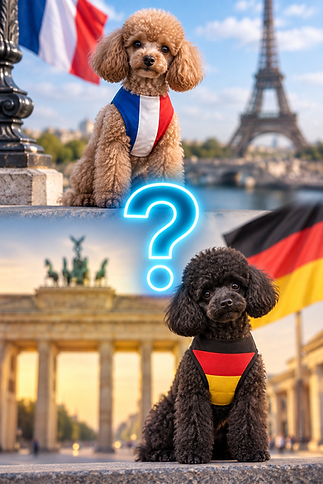
Who is right?
The question is probably wrong to begin with.
Modern dog breeds, with written standards, pedigree records and official breed clubs, are relatively recent. Long before anyone decided which country was allowed to put its flag next to the name “Poodle”, water dogs with thick, curly or woolly coats were already being used for similar tasks in different parts of Europe. So we shouldn't imagine the birth of the breed like this:
“On 14 May 1632, the first Poodle was born behind a French farmhouse.” It didn't happen that way.
The modern Poodle developed over generations from populations of working dogs that shared certain useful characteristics.
And one of those characteristics was particularly important.
A coat that works in water
The Poodle's coat did not evolve so that, several centuries later, we could give it a Teddy cut.
Although we have to admit it turned out to be rather convenient for that. Its dense, curly coat offered protection from cold and water. For a dog that repeatedly had to enter lakes, rivers and marshy areas, that had an obvious practical advantage.
But it also had a drawback. A lot of wet hair is heavy.
And this brings us to one of the most curious chapters in the history of the breed.
The hunter’s strange haircut
Imagine a Poodle in a Continental Clip.
Shaved hindquarters. Plenty of coat around the chest.
Pompons on the legs. Hair left around certain joints.
A pompon on the tail. Looking at it today, you might think:
“Someone got a little too enthusiastic with the scissors.”
But behind the traditional ways of clipping water dogs there was originally
a practical idea. Hair was removed from areas where it could restrict movement
and left in others where it could provide protection.
The aim was not to score ten points at a dog show. It was to allow the dog to swim and work more comfortably.
Over time, that functional logic was stylised, exaggerated and transformed by fashion, eventually producing some of the clips we now immediately associate with the Poodle. So the next time someone looks at a Continental and says:
— That looks so artificial. We can answer:
— Yes… but its conceptual great-grandfather was chasing ducks.

Did the pompons really protect the joints?
This is a good place to pause for a moment. Because the history of the Poodle is full of explanations that have been repeated so many times online that they eventually begin to sound like proven historical facts. One of the best-known claims is that hair was deliberately left around the joints and vital organs to protect them from the cold, while the rest of the body was shaved to make swimming easier.
The explanation is perfectly plausible. But proving that every element of the modern clip originated for exactly that reason is much more difficult. Grooming styles changed over the centuries, and today's clips are the result of an evolution in which function, tradition, aesthetics and show regulations all became intertwined.
So when we talk about history on this page, we are going to separate three things:
what we know, what seems likely, and what has simply been repeated many times.
Because “I've read it on 400 websites” does not automatically turn something into a 17th-century document.
Before the Poodle, there were dogs that looked suspiciously like Poodles
Long before the modern Poodle existed, we already find depictions of European dogs with woolly or curly coats associated with water work and hunting. This brings us to a much broader historical family: the European water dogs.
The French Barbet is probably the name that appears most often when discussing the Poodle's ancestors, although reconstructing the exact relationships between ancient dog populations is much more difficult than some online family trees would have us believe.
Other European water dogs with related characteristics also existed — and still exist today. That does not mean we can simply draw a neat family tree: Dog A + Dog B = Poodle. The history of ancient dog breeds rarely works like that.
For centuries, dogs were selected mainly by asking one fairly simple question:
“Can it do the job I need it to do?” If the answer was yes, it was bred.
The stud book could wait another few centuries.
The Poodle wasn't a little gentleman just yet
And this is perhaps the funniest part when you know the Poodle of today.
We're talking about a dog that can now wear a perfectly positioned bow, sleep under a blanket, have shampoo specifically formulated for its coat colour, conditioner, a hair mask, volumising spray and probably a better-organised grooming schedule than its owner.
But underneath all of that is a working dog.
Intelligent. Active. A good swimmer. Quick to learn. Attentive to human signals.
And those very characteristics that had made the Poodle so useful around water were about to trigger the next great turning point in its history. Because someone discovered that this dog could do more than retrieve birds.
It could learn almost anything.
And when humans discover an intelligent animal, one of two things usually happens:
we give it more work… or we put it on a stage. With the Poodle, we did both.
From the water to the drawing room: when the Poodle discovered life could be much more comfortable
At some point in its history, the Poodle gradually began to leave the hunting grounds behind and enter a completely different world.
Wealthy homes. Royal courts. Drawing rooms. Fashion. And France had a great deal to do with this transformation.
Its intelligence, striking appearance and, above all, a coat that could be styled in almost any imaginable way made the Poodle a perfect candidate for a new career as a companion dog. The former water worker had discovered a new profession: looking spectacular.
And it turned out to be extraordinarily good at it.
But something was still missing. It needed to be smaller.
Much smaller.Having a large water dog in the drawing room was all very well.
But being able to put a small one on your lap was even better.
And this is where another fascinating story begins:
how a working dog eventually became a Miniature Poodle and, finally,
a Toy Poodle.
From palace to circus: the Poodle discovers show business
Becoming an elegant dog had its advantages. There was less mud.
Less cold water. And, generally speaking, considerably fewer ducks.
As the Poodle became increasingly popular as a companion dog, particularly in France and other European countries, it began to appear more and more often among the wealthy classes. And it was easy to understand why. It looked different.
Its coat could be styled in a thousand different ways. It was attentive, expressive and remarkably easy to train.
It also possessed one quality that is particularly dangerous for any dog hoping for a quiet life: it enjoyed working with people.
The Poodle had left the water behind. But it was about to discover that humans had some new ideas for it.

From working dog to fashion dog
During the 17th and 18th centuries, small companion dogs became a familiar part of European aristocratic life.
Not all of them were Poodles, of course. Paintings from the period show numerous breeds and types of small dogs.
But the Poodle had one advantage that few others could offer: it was customisable. Not genetically. Aesthetically.
Its coat kept growing and could be clipped, shaped and decorated in increasingly elaborate ways.
In a society where clothing, wigs, lace and hairstyles could say a great deal about a person's social status, having a dog that could also be transformed into a small work of hairdressing art had definite potential.
It was only a matter of time. The man wore a wig. The woman wore a hairstyle half a metre high.
And someone looked at the Poodle. The poor dog never stood a chance.
Was the Poodle really the favourite dog of the French court?
Here we come across another claim that gets repeated a great deal: “The Poodle was the favourite dog of the French aristocracy.”
There is some truth behind the idea, but we should probably avoid turning it into a Disney film.
Poodles and similar-looking dogs appear in wealthy settings and became very popular in France. However, European courts were full of many different kinds of dogs. Small Spaniels, Bichons, Pugs, little lapdogs… The aristocracy never issued a decree saying:
“From Monday onwards, everyone must have a Poodle.” Its popularity grew gradually.
And France eventually played an enormous role in the development of the modern breed.
So much so that, centuries later, the FCI would officially recognise France as its country of origin.
But while the wealthy were discovering that a Poodle looked splendid in a drawing room, other people discovered something even more interesting. This dog could learn numbers.
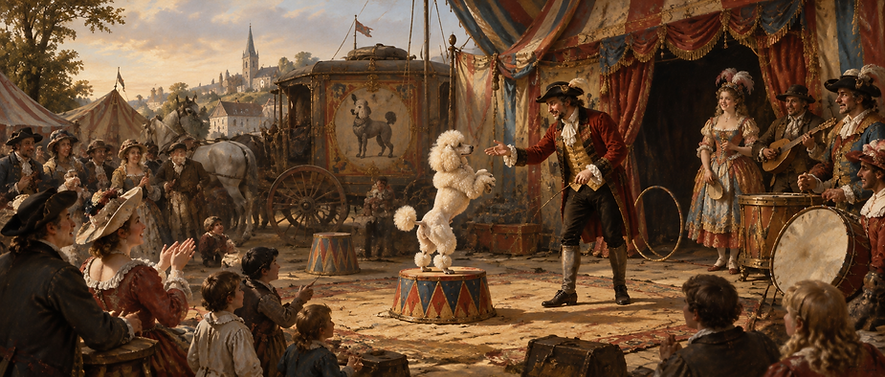
Ladies and gentlemen: the Poodle
To understand why the Poodle eventually became associated with circuses and travelling performers, we need to forget about its coat for a moment. What really mattered was underneath it. The brain. A dog capable of working with a hunter had to observe, wait for instructions, remember tasks, control its impulses and cooperate with a person at a distance.
Those abilities could be put to use in a completely different way. Walking on its hind legs. Jumping. Spinning.
Fetching specific objects. Pushing little carts. Acting out scenes. Responding to almost imperceptible signals.
And, above all, learning long sequences of behaviours.
Travelling performers across Europe discovered that the Poodle was an extraordinary partner.
And it had another advantage. You could see it from a distance. A curly dog with an eye-catching clip performing complicated tricks attracted an audience. The former duck retriever had just found a job in show business.
The dog that seemed to understand mathematics
Dog performances became surprisingly sophisticated.
There were animals that apparently counted, recognised letters,
selected particular objects or answered questions.
Does that mean there were Poodles solving equations? Unfortunately not.
We would have solved quite a few breeding problems long before genetic testing
was invented. Usually, these acts relied on extraordinarily precise training.
The dog learned to respond to tiny human signals: body movements,
changes in posture, gestures or previously trained cues.
To the audience, it looked like magic. To the dog, it was work.
And to the trainer, it was the perfect demonstration of just how far an animal
with an extraordinary ability to observe could go.
Munito: a Poodle who became a celebrity
At the beginning of the 19th century, we come across one of the most curious names
associated with this tradition: Munito.
Munito was a famous dog known for performances that seemed to demonstrate
almost human abilities. He was credited with feats involving numbers,
cards and answering questions, and his performances attracted enormous curiosity. Naturally, audiences debated how he did it.
Did he really understand? Was he receiving signals? Was there some kind of trick? The most likely answer requires no supernatural powers. It requires something that anyone who has lived with Poodles for many years will recognise immediately: a dog watching a human with an almost uncomfortable degree of concentration. Because a Poodle can learn to read our signals. Even the ones we don't realise we're giving. And that is what turned dogs like Munito into stars.

The circus also helped change the Poodle's appearance
Something interesting happened here. A show dog did not have the same needs as a dog working in the water. There was no longer any need to keep the clip purely practical. Now appearance itself could become part of the performance. Hair could be left longer in certain areas. Contrasts could be created. Silhouettes could be emphasised. Decorations could be added.
The movements of the legs could be made more visible. Grooming was beginning to be more than simply functional.
It was becoming part of the show. And this transformation is important for understanding the modern Poodle.
The history of its clips cannot be explained simply by saying: “This was done to protect the kidneys, and that was done to protect the joints.” That explains part of the tradition. Then came centuries of fashion, performance, creativity and aesthetic selection.
The hunter put the scissors down on the table. The performer picked them up.
And the groomer still hasn't let go of them.
Napoleon, wars and a Poodle named Moustache
And now we enter an area where history and legend begin to mix rather dangerously.
There is a famous Poodle associated with the Napoleonic Wars: Moustache.
According to numerous later historical accounts, Moustache accompanied French soldiers, took part in military campaigns and became known for his courage and loyalty. The most spectacular versions claim that he warned soldiers of an attack, retrieved a flag during battle and even received some form of recognition for his actions.
It sounds wonderful. Perhaps a little too wonderful. The problem is that, as with many famous dogs from the days before photography and modern records, the story was told and retold. And every time a good story is repeated for a hundred years…
the dog usually runs a little faster, saves one extra person and comes back carrying a slightly bigger flag.
That is why Moustache deserves a place in the history of the Poodle.
But with one important label: History, tradition and legend.
We know that dogs accompanied armies and soldiers for centuries, performing many different roles. There are also historical accounts of Poodle-type dogs associated with military campaigns. What is much more difficult today is proving every detail of the adventures attributed to one particular dog. So there is no need to remove Moustache from the story. Quite the opposite.
He reminds us of something important: the history of a breed is also made up of the stories people chose to preserve about it.
Even if some of those stories grew just a little along the way.
And when did the little one appear?
So far, our protagonist could work in the water, accompany hunters, live among aristocrats, perform in front of audiences and even appear in military stories. But there is still one rather obvious thing we need to explain. We look at a Standard Poodle.
Then we look at a 24-centimetre Toy. And a reasonable question arises: What happened in between?
Because the Toy Poodle did not suddenly appear one morning after two large Poodles produced a two-kilo genetic surprise.
The reduction in size was a process of selection.
Over generations, people bred smaller individuals to produce dogs particularly well suited to companionship and performance.
And the more the dog's role changed, the more opportunity there was for its size to change as well.
To retrieve a duck from cold water, a certain amount of size and strength was useful. To sit on a cushion… the requirements were somewhat different. And so begins one of the most curious chapters in our story: how we managed to fit a water dog into a handbag without, essentially, stopping it from being a Poodle.
From hunter to Toy: how we shrank the Poodle
So, we have a small problem. We have a water dog. It swims well.
It retrieves birds. It is tough, active and large enough to work in some fairly
demanding conditions. And a few centuries later, we have this:
a 23-centimetre Toy Poodle that weighs little more than a chicken.
Something clearly happened along the way. And no, it did not happen overnight.
First, we need to forget today's four sizes. Today, we are used to talking about:
-
Standard Poodle
-
Medium Poodle
-
Miniature Poodle
-
Toy Poodle
The classification feels so natural that it is easy to imagine four Poodles neatly arranged by size since the Middle Ages.
Standard. Medium. Miniature. Toy. Like Russian nesting dolls.
But the modern size varieties did not appear simultaneously, nor were they originally defined by the measurements we use today.
For much of history, there were simply Poodle-type dogs of different sizes, selected for different jobs and human preferences.
The precise classification came much later. First came the dog. Then humans arrived with a measuring tape. As usual.


Why make it smaller?
Because not every Poodle needed to do the same job anymore. Once a breed is no longer selected exclusively for one particular function, new possibilities begin to appear. A large dog could still be excellent for working in water.
A smaller one could be particularly convenient as a companion. It could also travel more easily, live comfortably indoors and take part in performances. And there was another extremely important reason: people liked small dogs.
We don't always need to look for a complicated explanation. For centuries, humans have looked at a smaller version of something and said: — Awww. And then tried to make it even smaller. That is exactly what happened with Poodles.
By selecting smaller individuals over successive generations, increasingly small populations gradually became established.
It wasn't a Poodle that suddenly shrank. It was selection.
Was the Miniature Poodle created to hunt for truffles?
And here comes one of our first guests.
🥁 THE MYTH
“The Miniature Poodle was specifically created to hunt for truffles.”
It sounds wonderful.
It also contains all the ingredients needed for success on the internet:
France. An elegant dog. Forests. Truffles.
All that's missing is a glass of wine.
Is there any truth to it? Yes.
Small Poodles were used to search for truffles, and there is
nothing particularly surprising about that.
The Poodle has a good sense of smell, intelligence, an ability to learn quickly and a strong desire to work with people.
A relatively light dog can also move easily over the ground without destroying the very thing it is trying to find.
Perfect. The problem begins when we move from: “Poodles were used to search for truffles” to:
“the Miniature Poodle was created to search for truffles.” Those are not quite the same thing.
The reduction in the Poodle's size was part of a much broader process of selection as a companion and performance dog, and later as a distinct size variety. So yes: a Poodle can hunt for truffles.
But an entire Poodle size probably did not come into existence because a Frenchman lost a very expensive mushroom.

Was the Toy Poodle created to keep ladies' hands warm?
Welcome to our next classic.
🥁 THE MYTH
“Toy Poodles were bred so that aristocratic ladies could carry them in their sleeves and use them to keep their hands warm.”
This story is irresistible.
A marquise. Versailles. An enormous dress.
And inside the sleeve: a Poodle.
We have a few questions.
Did it climb in through the cuff, or did someone have to put it in from
the shoulder? Did its head stick out?
What happened if it saw a squirrel?
Was there a maid specially trained to remove Poodles from sleeves?
Unfortunately, the historical evidence does not always match
the enthusiasm with which this story is repeated.

What we do know
Small companion dogs were enormously popular among Europe's wealthy classes.
They were carried in people's arms, kept close to their owners, and particularly tiny dogs could easily be taken almost anywhere.
There are also historical references to small lapdogs being kept as close physical companions and even used as a source of warmth.
But there is quite a leap from that to claiming that the Toy Poodle was specifically created as portable heating for aristocratic ladies.
It makes far more sense to understand its development as part of a broader trend towards increasingly smaller Poodles, bred primarily for companionship and performance.
Although we have to admit one thing.
“Portable aristocratic heating — Poodle model” would have made an excellent advertising campaign.
Were small dogs used to attract fleas?
Ah. This one is even better.
There is a whole family of stories claiming that aristocratic ladies kept small dogs
close to their bodies so that the fleas would prefer the dog and leave
their owner alone. The idea would be something like: a four-legged flea repellent.
Could a flea move from a person to an animal?
Of course. Does that mean Europe developed miniature breeds
as official flea-catching devices? No.
And if someone had deliberately designed a Poodle with a thick coat only to then
try to find a flea somewhere inside it… they had an extraordinarily
dark sense of humour. Once again, we run into the same historical problem: a possible practice or an anecdote gets repeated so many times that it eventually becomes “the reason the breed was created”. That is not how it works.

So when did the Toy actually appear?
Here we need to distinguish between two things: the existence of very small Poodles and the official recognition of a size variety
called Toy. They are not the same thing.
For a long time, small Poodles could exist without there being an international canine classification that corresponded exactly to the modern Toy Poodle. Organised cynology changed all that.
By the late 19th century and throughout the 20th century, breed clubs, stud books and increasingly detailed standards were being developed. And then began an activity that humans absolutely love: measuring things. Height. Proportions. Head. Body. Colour.
Dentition. And, naturally, size.
What had once been a continuous population of Poodles of different sizes gradually began to be formally divided into distinct varieties.
It was no longer enough for a Poodle simply to be small. Now it had to prove exactly how small it was.
The goal wasn't to create just any miniature dog
Making a breed smaller sounds simple. Choose the smallest dogs. Breed them. Choose the smallest ones again. Done.
Except it isn't.
Because if we select only for size, we can end up with a small dog that no longer retains the proportions, structure, movement or type of the original breed. The real challenge was to achieve something much more difficult:
a complete Poodle inside a small body.
Not an enormous head on tiny legs. Not a fragile dog with disproportionately large eyes. Not just “something small and curly”.
A Poodle. That remains one of the fundamental principles of the modern breed standard.
The smaller varieties should retain the breed's overall characteristics within their respective scale.
In other words: the Toy should not look like a caricature of the Standard Poodle. It should look as though someone opened Photoshop and clicked: Resize to 35%. Maintain proportions.
Standard, Medium, Miniature… and finally Toy
As European cynology developed, the different size varieties gradually became established.
The Standard Poodle retained the size closest to that of the old working dog.
The Medium Poodle represented an intermediate size that was very common in Europe
for many years. The Miniature Poodle took the reduction in size considerably further.
And finally, we arrive at the Toy Poodle.
Today, according to the FCI standard, the four varieties are distinguished by height at the withers:
Standard Poodle: over 45 cm and up to 60 cm, with the additional tolerance specified in the standard.
Medium Poodle: over 35 cm and up to 45 cm.
Miniature Poodle: over 28 cm and up to 35 cm.
Toy Poodle: over 24 cm and up to 28 cm, with a tolerance of 1 cm below.
And this is where our story becomes particularly interesting.
Because today we look at a 25-centimetre Poodle and immediately think: Toy.
But for centuries, that word would have meant absolutely nothing to someone standing
in front of a small curly dog. The categories are modern. The dog is much older.

And do we always try to make it even smaller?
Of course. We're human. As soon as we had the Toy Poodle, someone inevitably came along and said:
— Very nice. But couldn't it be smaller? And so we enter the wonderful world of marketing terms such as:
Tiny Toy. Teacup. Micro Toy. Very attractive names. There is just one small detail.
These are not sizes recognised by the FCI
Under the FCI standard, there is no variety called Teacup, Tiny Toy or Micro Toy. There is the Toy Poodle.
An individual dog may naturally remain below the desired size, just as any population contains larger and smaller individuals.
But giving it a new marketing name does not automatically create a fifth size variety.
A 20-centimetre Poodle does not scientifically transform into a: Poodle Toy Premium Pocket Edition.
It is simply an extremely small Poodle. And the more we pursue extreme sizes, the more important it becomes to remember that selection should not simply reduce centimetres. It must preserve structure, proportions, dentition, movement, temperament and health.
Because it took us centuries to fit that old water dog into such a tiny body.
It would be a shame if, after all that work, size were the only thing we had left.

And this is where the story ends… more or less
After all these centuries, the result is rather curious. We started with a dog that went into the water to retrieve birds.
We watched it gradually leave exclusively hunting work behind. It moved into people's homes. Then into drawing rooms.
It stepped onto the stage. Learned tricks. Appeared in stories of soldiers and wars. We cut its coat.
Then we let it grow. Then we cut it again, only this time in much more complicated ways.
We made it large, medium-sized, small and finally so tiny that an adult duck might seriously wonder who is supposed to retrieve whom.
And after all that, we still have a Poodle. Perhaps that is one of the most extraordinary things about the breed.
Its appearance and its role have changed enormously without losing the quality that probably made humans notice it in the first place: its extraordinary ability to learn and work with us. The hunter needed a dog capable of understanding what he wanted.
The performer needed exactly the same thing. So did the lady who wanted one as a companion. And so does the modern exhibitor.
And several centuries later, we still have a small curly creature at home that watches absolutely everything we do and learns things that nobody remembers ever teaching it.
From ducks to the sofa. It is difficult to know what one of those old water dogs would think if it could meet its modern descendants.
It would probably recognise the coat. It would recognise the willingness to work. It would recognise that constant attention to humans.
Then it would see the shampoo, conditioner, hair mask, volumising spray, dryer, scissors, bands, carbon comb and grooming table…
and perhaps decide to go straight back to the marsh.
But let's not fool ourselves. We would show it the sofa. And it would probably stay.
But the Poodle didn't stay in Europe.
Here we have followed the story of how the breed originated and evolved. But there is another, completely different story still to tell.
What happened when the Poodle began to travel? How did it reach other countries? Where did it become particularly popular?
How did Poodle breeding develop outside France and the rest of Europe? And how did it eventually become one of the most recognisable dog breeds on the planet? That deserves a journey of its own.
Because leaving the water behind, conquering the aristocracy, succeeding in show business and eventually becoming a Toy is already quite an achievement. Conquering the entire world was simply the next step.