
Poodles Around the World / Poodle Geography
The poodle is one of the few breeds found all over the world. But its popularity, style, and role vary from country to country.

🇺🇸 The Poodle in the United States. A breed that made a comeback
The poodle is not just an elegant or intelligent dog. In the United States, it is one of the few breeds whose
popularity has shown something much more difficult: returning to the top after decades.
🟡 22 Years at Number One
For much of the 20th century, the poodle completely dominated dog registrations in the U.S.
According to the American Kennel Club,
👉 the poodle was the most registered breed in the United States for 22 consecutive years (1960–1982).
This was not a short-lived trend — it was an entire era dominated by a single breed.
🟡 Where Did It All Begin?
The official recognition of the poodle in the United States dates back to: 👉 1887, when the American
Kennel Club first registered the breed. Since then, its presence has never disappeared from the American canine scene.
🟡 From the Top… to a Decline
Like all breeds, the poodle also experienced a period of decline. For several decades: – it was no longer number one, – it was replaced by new “trendy breeds”, – it lost visibility in popular rankings. But this is where its story becomes different.
🔥 A Popularity That Returns
In recent years, the poodle has made a strong comeback. 👉 It is now back in the TOP 5 most registered breeds in the U.S.
Not as a passing trend, but as a solid return.
💡 Why Is the Poodle Coming Back?
Because it does not depend on fashion. The poodle combines qualities that remain relevant in any era: – exceptional intelligence,
– adaptability, – versatile size, – balanced temperament, – excellent compatibility with humans. 👉 When trends fade, these qualities matter again. 🟡 The Poodle in American Culture. The poodle has not only been popular in numbers, but also in culture.
Some well-known figures who have had poodles: – Elvis Presley — gave a poodle as a gift to his partner, – Winston Churchill — had poodles in his environment, – Barbra Streisand — a well-known admirer of the breed.
🟡 More Than a Trend
Unlike many breeds that rise and fall quickly in popularity, the poodle shows something different: It may disappear from the spotlight…
but it always comes back.
🇫🇷 The Poodle in France. Elegance, style, and a unique identity
When most people think of the poodle, they think of France. But the story is more interesting.
🟡 A French Dog? Although the poodle is strongly associated with France, its origin is not
French. The name “poodle” comes from the German pudel, meaning “to splash in water.”
👉 However, it was in France that the poodle found its true identity.
🟡 Official Recognition of the Breed
The development of the poodle in France was not only aesthetic, but also official.
The breed was internationally recognized by the Fédération Cynologique Internationale as
the reference standard under the French denomination. 👉 The breed is registered as:
“Caniche (Poodle)” — with France as the official country of reference. The poodle was not born in France, but France defines its official standard. 🟡 The Country That Shaped Its Image. France did not create the poodle… but it created the image we know today.
This is where the breed became: – an elegant dog, – an aesthetic icon, – a reference in dog shows.
👉 The French poodle is not just a dog — it is a visual identity.
🟡 Shows and Style
In France, the poodle is closely linked to the world of presentation and grooming. Under the influence of the Fédération Cynologique Internationale: – classic grooming styles were established, – proportions were defined, – the elegant image of the breed was reinforced. 👉 This is where the silhouettes we see worldwide were shaped.
🟡 The Poodle in the French Court
In the French court, dogs were not just companions — they were part of the image. The poodle stood out because it:
– had a unique appearance, – could be styled and groomed like no other breed, – conveyed elegance even at rest.
👉 That’s why it became a favorite in refined environments. It was not just a beautiful dog. It was a dog that represented status.

🇯🇵 The Poodle in Japan. Perfection in the details.
In Japan, the poodle is not just a companion dog. It is a combination of: – aesthetics,
– meticulous care, – a culture of detail. 🟡 One of the Most Popular Breeds. In Japan, the poodle
— especially the toy — is one of the most common breeds in urban life. 👉 Perfectly adapted to:
– small apartments, – city living, – close daily interaction with humans. 🟡 The Art of Grooming.
If there is a place where the poodle transforms, it is Japan. Japanese grooming is known for:
– soft, rounded shapes, – a “teddy bear” expression, – cuts that highlight the face and eyes.
👉 It’s not just maintenance. It’s art. 🟡 A Different Aesthetic. Compared to the European style:
– less rigid structure, – more softness, – more emotional expression.
👉 The goal is not to impress… 👉 but to charm. 🟡 A Culture of Care. In Japan, dog care reaches another level:
– frequent grooming visits, – attention to every detail, – constant hygiene. 👉 The poodle fits perfectly into this philosophy.
🟡 Relationship with Humans. In Japan, the poodle is: – very close to its owner, – part of everyday life, – almost an emotional extension. 👉 It is not just a pet, 👉 it is constant companionship.
🔥 Japan did not change the origin of the poodle… but it changed the way we see it.
In Japan, the poodle does not impress. It captivates.

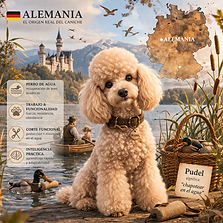
🇩🇪 The Poodle in Germany. The true origin of the breed.
Before becoming a symbol of elegance in France, the poodle was something completely different.
👉 In Germany, the poodle began as a working dog. 🟡 Where Does the Poodle Come From?
The name itself reveals it. The word “poodle” comes from the German pudel, meaning:
👉 “to splash in the water.” This is not a coincidence. 🟡 A Water Hunting Dog. In its origins,
the poodle was used to: – retrieve waterfowl, – work in lakes and rivers, – swim long distances.
👉 It was a strong, resilient, and highly functional dog. 🟡 The Logic Behind Its Appearance.
Even its famous grooming style has a practical origin. – Areas with more hair protected vital
organs from the cold. – Shaved areas improved movement in the water. 👉 Nothing was decorative. Everything had a function.
🟡 Intelligence Applied to Work. The poodle was not only physically capable. It also stood out for:
– quick learning, – obedience, – adaptability. 👉 This made it an ideal dog for complex tasks. 🟡 Before Elegance. In Germany, the poodle was not a status symbol. It was: – a working dog, – a helper, – a practical tool.
👉 Appearance was not important. Functionality was everything. 🔥 The poodle we see today cannot be understood without Germany.
Before it was elegant… the poodle was efficient.
🏜️ The Poodle in the Arab World. Modern luxury and a new canine culture.
In the Gulf countries, the poodle is not part of traditional history. Its presence is much more recent.
👉 And precisely because of that, its role is different. 🟡 A Breed Without a Past in the Region.
Unlike Europe, where the poodle has centuries of history, in many Arab countries it has not been
a common breed. Traditionally, dogs in the region were associated with: – hunting, – protection,
– practical functions. 👉 Companion breeds like the poodle were not typical. 🟡 A Change in Recent Years
In countries such as: – United Arab Emirates, – Saudi Arabia, – Qatar a new culture has developed:
– more urban, – more international, – with a growing presence of pets in everyday life.
👉 This is where the poodle appears. 🟡 The Poodle and Modern Life.
The poodle fits perfectly into this new environment. Because it is: – clean, – adaptable, – suitable for indoor living,
– easy to manage in urban spaces. 👉 In modern, climate-controlled cities, these qualities are essential. 🟡 Grooming and Lifestyle.
In today’s Arab world, dog care is growing rapidly. There is a rise in: – grooming salons, – specialized services, – attention to the dog’s appearance. 👉 The poodle stands out for its ability to transform aesthetically. But here, it’s not about art as in Japan.
👉 It’s about care and lifestyle. 🟡 A Different Perception. In this region, the poodle is not: – a working dog, – a historical symbol.
👉 It is: – a modern choice, – part of an urban lifestyle, – a companion associated with the present.
🔥 In the Arab world, the poodle has no past…but it has an increasingly visible present.

🇰🇷 The Poodle in South Korea. Trend, image, and visual perfection.
In South Korea, the poodle is not just a pet. It is part of a culture where image and style matter.
🟡 A Fully Integrated Breed. In South Korea, the poodle — especially the toy —
is one of the most common breeds in urban life. 👉 Adapted to: – apartments, – city living,
– constant close contact with the owner. 🟡 A Culture of Image. South Korea is a country where:
– aesthetics are important, – personal care is part of daily life, – image communicates identity.
👉 And this also applies to dogs. 🟡 Grooming as a Trend. In Korea, grooming is not
just care — it is a trend. It is characterized by: clean, very defined cuts, symmetry, extreme
attention to detail. 👉 The goal is not just for the dog to look nice. 👉 but to look perfect at all times.
🟡 Influence of Social Media. The poodle in Korea is closely linked to: – Instagram, – visual content, – digital lifestyle.
👉 Many dogs: have a carefully styled appearance, appear in content, are part of a lifestyle image.
🟡 Different from Japan. Although it may seem similar, there is a key difference:
Japan → softness, cuteness, emotion. Korea → precision, style, trend.
👉 Japan charms 👉 Korea impresses
🟡 Relationship with the Owner. In Korea, the poodle:
– lives very close to humans
– becomes part of their image
– shares their lifestyle
👉 It is a companion… but also a form of personal expression 🔥 In South Korea, the poodle is not just cared for…it is presented.
