
Canine Language. How to Understand Your Dog

How to Understand Poodle Body Language.
The language that doesn’t need words.
The poodle not only learns quickly. It also communicates constantly.
The problem is not that dogs cannot speak… it’s that very often we simply don’t know how to listen.
Your dog is telling you things all the time, in its own way:
through the eyes, posture, tail, ears…
and sometimes also at 3 a.m. by walking across your head
because apparently “something extremely important” is happening in the garden. 😅
And when we don’t understand what the dog is trying to communicate…
the situation starts looking a lot like parents staring at a small child
crying while trying to guess: “hungry?... sleepy?... pain?”
Dogs make an enormous effort to understand us.
They learn human words, routines, tones of voice, schedules… and probably
also the word “no”, even if they choose to ignore it selectively. 😏
So it only seems fair that we also spend a little time
trying to understand their language. Because very often, training a dog does
not begin with teaching commands… but with first learning how to listen.


The Eyes
Soft direct eye contact — trust and connection. People say that the eyes are the mirror of the soul… and with dogs this is incredibly true as well. When a poodle looks at you in a calm and gentle way, it usually means: trust, interest, a desire to connect with you. It is the classic look of: “yes, human, I’m with you.”
Fixed and intense eye contact — maximum attention (or waiting for a command).
At this point the dog is already in “satellite antenna mode.” 📡
Watching, analyzing, trying to predict what you are about to do.
Yes… many poodles absolutely love being “good boys” and “good girls.”
Sometimes you have not even said anything yet and the dog is already prepared to:
- sit, - run, - fetch the ball,
- or become excited for no obvious reason… “just in case.”
Distant or unfocused gaze — something is not right.
When a dog looks “through you,” seems less expressive, and the eyes even
appear slightly smaller than usual… it often means:
👉 pain,
👉 discomfort,
👉 sadness,
👉 or simply that the dog is not emotionally well.
And this is not an exaggeration.
Look into the eyes of a dog that has lost its owner.
The expression changes completely.
Avoiding eye contact — discomfort or an attempt to calm the situation.
This one is an absolute classic.
You come home… and discover:
👉 a destroyed pillow,
👉 half a forest made from toilet paper,
👉 and a contemporary art installation in the living room.
Then you ask: “Ooooh… who did this?”
And interestingly… if there are two dogs, you can usually tell immediately
which one was the mastermind behind the project.
The Tail.
Tail held high - confidence and self-assurance.
In a Toy Poodle, this can look especially funny.
During a walk, it sometimes seems like you are not walking the dog...
the dog is walking you. With its tail held proudly high and a confident stride,
it looks as if it is saying: "Don't worry, I'm here. Everything is under control."
A high tail usually means the dog feels confident, relaxed and comfortable
in its surroundings. And, to be fair, many little Toy Poodles really do behave
as if they are the personal bodyguards of the entire family.
Tail held level with the body - assessing the situation.
This position can mean interest, alertness or mild tension.
The dog is carefully watching everything around it before deciding how to react.
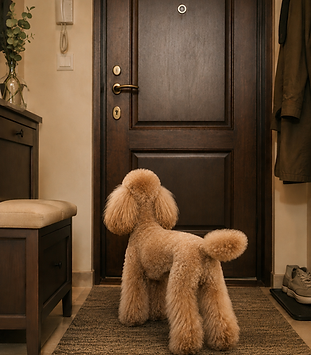
Toy Poodles often stand like this when they are waiting for their favorite person.
They sit by the door like a little guard, listening carefully for every tiny sound.
And when you finally arrive, their expression seems to say:
"About time! I've been waiting for you for five minutes... or maybe five hours."
A tail held level with the body usually means the dog is focused,
paying close attention to its surroundings and carefully assessing the situation.
Tail held low, but not tucked between the legs -
tiredness, mild insecurity or weakness.
This position may also simply mean that the dog is calm or a little tired.
Always look at the dog's overall body language rather than
judging by the tail alone.
And here's something many Toy Poodle owners will recognize:
quite a few of them seem to hold their tails like this...
but only when they notice a camera.
The moment you take out your phone to capture the perfect photo,
the proud tail suddenly "disappears." As soon as you stop taking pictures,
it goes right back up as if nothing had happened.
Tail tucked between the legs - fear and insecurity.
This is a very clear sign that the dog feels uncomfortable or frightened.
It is trying to make itself look smaller and avoid whatever is causing concern.
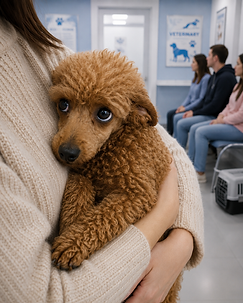
And there is one place where even the bravest Toy Poodles seem to forget all
about their courage: the veterinary clinic. Just five minutes earlier they were
strutting down the street as if they owned the whole neighborhood...
and suddenly the tail disappears between the legs while the expression
seems to say: "Can we please go home now?"
At moments like this, the best thing you can do is stay calm and
reassure your dog.
Your confidence and relaxed attitude will help your Toy Poodle feel safer too.
Tail position should never be interpreted on its own.
Body tension, ears, and eye expression also matter.
- Wide, relaxed tail movements — happiness.
- Small, fast tail movements — excitement (not always positive).
It is not simply “tail wagging = happy.” Speed and tension matter too.
Sometimes the dog is trying to appear more confident than it actually feels.
It is similar to a person entering an uncomfortable social situation and smiling to avoid conflict.
A stiff tail pressed tightly against the belly — panic or very intense fear.
The Ears.
Ears in poodles are a funny subject. In many breeds, ears are one of the main emotional indicators. In toy poodles… not always.
Their ears are relatively large for their body size, heavy because of the coat, and honestly… many poodles seem far too elegant to waste energy moving them all the time. 😏
Most of the time the ears simply hang in a relaxed position.
Relaxed ears — calm and comfortable.
Sometimes a poodle pulls the ears slightly backward. Usually this happens:
- during introductions to another dog, - when carefully analyzing the situation,
- or when a little tension appears.
Slightly back — tension or uncertainty.
Strongly pinned back — fear, submission, or “okay okay… you are clearly the boss here.”
And then there is the famous “satellite ear mode.” If the ears suddenly start sticking slightly sideways
instead of hanging normally… very often the problem is not emotional at all.
It may be an ear infection, irritation, or even ear mites.
The dog is basically trying to ventilate the ears.
The Body.
Loose body → confidence. Stiff → tension. Leaning toward you → interest. Moving away slowly → wants to keep distance.
Typical Poodle Signals.
Follows you constantly → strong bond. Looks at you before acting → seeking approval. Makes small gestures (look, step, pause) → attempts to “communicate” with you.
Signals Many People Misinterpret.
Important for trust: “tail wagging = happy”, ✔️ it can also mean stress, “standing still = calm”, ✔️ the dog may be frozen or blocked.
The poodle doesn’t just understand humans… it also expects to be understood.
Understanding a poodle is not about guessing. It’s about observing: small gestures, subtle changes, constant signals.
The more you watch… the more it communicates.




🐺 The Poodle… and Its Wolf Past. A story that is still alive.
Yes, the poodle is elegant, intelligent, and adorable. But… deep down, it is still a dog,
and the dog is a wolf… shaped over centuries.
🟡 A Wolf with Wi-Fi.
Dogs did not appear out of nowhere. They are the result of thousands of years living alongside humans.
Some things changed: less aggression, more adaptability, stronger communication with people
But others remain: body language, social instincts, need for structure
🟡 The Memory of the Pack.
In a wolf pack, everything works with clear rules: who leads, who follows, who decides, and who waits. There is no chaos.
There is constant communication — without words
🟡 How Do Wolves “Speak”?
Wolves use: posture, tail position, gaze, distance. Exactly the same signals your poodle uses.
🟡 Signals of Hierarchy.
In a pack: 🐺 Direct gaze → challenge or control. 🐺 Avoiding eye contact → respect.🐺 Approaching with a lowered body → submission. 🐺 Stiff body → tension or warning.
🟡 What Changed in Dogs?
Over time: some signals became softer, others became stronger. For example: less direct aggression, more subtle gestures,
more communication with humans.
🟡 The Poodle Takes It Further.
The poodle doesn’t just keep this language… it refines it. It watches constantly, adjusts its behavior, reacts to micro-signals,
like a wolf… but specialized in understanding humans.
🟡 What We Often Don’t See.
When your dog: looks at you before acting, stays still, moves closer or away, it’s not “doing something strange”,
it’s using a very ancient language. Your dog does not behave like a human… it communicates like a wolf.
Understanding a poodle becomes easier when you remember this: you don’t need to teach it how to communicate,
it already knows. You just need to learn its language.
Human Mistakes… from the Dog’s Point of View
(or how your poodle actually sees you ) Humans think we understand dogs. But if we look at it the other way around… some of the things we do are quite strange.
“I stare at you because I love you.” Human view: love, connection, affection. Dog’s view: direct stare = pressure. It may be interpreted as: control, discomfort. For a dog, too much eye contact… is too much.
“I hug him because he’s adorable.” Human: affection. Dog: loss of control over space. The dog cannot move, cannot choose, some tolerate it… others silently endure it.
“I say ‘no’ a hundred times.” Human: training. Dog: noise without meaning. There is no clear action, no clear signal. For a dog, repetition doesn’t teach… it confuses.
“I let him do anything because I love him.” Human: love. Dog: lack of structure. The dog doesn’t know what is expected, insecurity increases. In the dog’s world: clarity brings calm.
“I punish him after it already happened.” Human: correction. Dog: no connection. The dog lives in the present. It cannot link past action with punishment. Result: confusion, stress.
“I talk to him a lot.” Human: communication. Dog: too much information. The dog focuses on: tone, gestures, energy.
It doesn’t hear words… it interprets signals.
“I ignore him when he does something right.” Human: normal. Dog: no feedback. Dogs learn from immediate response. A dog doesn’t need you to talk more… it needs you to be clearer. From a poodle’s point of view: humans are not complicated… but sometimes they are inconsistent. When you understand how your dog thinks, everything becomes much easier.
Why Do Dogs Sniff Each Other’s Rear?
(and why it’s completely normal. )
It may seem strange to us… but for dogs, it is perfectly logical.
It’s their way of “introducing themselves.”
An Ancient Greeting. Dogs, like wolves, communicate through scent. The area
under the tail contains: – anal glands, – unique information about each individual.
It’s like a “complete profile.”
What Information Do They Get? When a dog sniffs another, it can learn: – sex, – approximate age, – emotional state, – health condition, – whether they’ve met before.
All in just a few seconds.
Their Way of Saying “Hello.” For a dog, this is equivalent to: “Who are you?”
“How are you?” “Do I know you?”
Why Do They Do It Every Time? Because it is: – fast, – precise, – natural.
They don’t need words or complex signals.
Should You Stop It? Usually, no. It’s a natural and necessary behavior for
communication. It should only be interrupted if: – one of the dogs is uncomfortable,
– there is tension. Where we see something strange… they see information. Dogs don’t
sniff out of habit. They sniff to understand each other. It’s their clearest form of communication. If your poodle does this… it’s not bad manners. It’s canine language.

Why Do Dogs Circle Before Lying Down?
(it’s not a habit… it’s history)
Before lying down, many dogs turn in circles. Sometimes once… sometimes five times. And it’s not random.
A Habit from Wolves. This behavior comes directly from their ancestors. Before resting, wolves would: – flatten the grass, – check the ground, – remove anything uncomfortable. Creating a safe place to rest.
Preparing the “Nest.” Even if your dog has a perfect bed… instinct tells it to: adjust the space, find the right position, make sure everything is in place.
Safety Before Resting. In nature, lying down is a vulnerable moment. Circling allows the dog to: check the surroundings,
confirm there is no danger, position itself strategically.
Temperature and Comfort. Another reason: adjust the body, find the most comfortable position, regulate contact with the ground.
When Is It Normal… and When Not? Normal: 1–3 turns before lying down. May indicate a problem: constant circling,
restlessness, unable to settle. Possible causes: – stress, – physical discomfort. Your dog doesn’t circle “for no reason”… it is preparing its place to rest. Even if it sleeps at home today, your dog still carries thousands of years of instinct inside.
Before sleeping… it first makes sure everything is in order.
If your poodle circles before lying down… it’s not hesitating. It’s thinking .