

Particolor Toy Poodles
🐩 Our Parti-Color Poodles
Long before parti-color poodles were officially recognized in the standard, we already believed in them.
It wasn’t a trend. It wasn’t a fashion. It was a conviction.
More than 10 years ago, when they were still not accepted in many countries, we were already working with these colors—studying their genetics, their development, and above all, preserving the correct Poodle type.
👉 This video is from 10 years ago:
by Valor Inter Plata
We were, without a doubt, among the first to work with parti-color poodles in Spain, at a time when they were rarely seen and poorly understood. Today, the standard has finally taken a step forward and recognized what for years was ignored.
But for us, parti-color poodles have never been “new.” They are part of our history.
Breeding colored poodles is not just about producing beautiful colors.
It means maintaining structure, temperament, and type — exactly as the standard requires.
Welcome to our parti-color poodle line. ✨
When we started breeding parti-color poodles, finding a toy poodle was practically impossible. We imported miniature poodles and bred them down in size. As a result, we ended up with mini toy poodles. But we like it.
All our parti-color poodles measure between 18 and 22 cm, but have the correct structure and weight for their size.
Male particolor Pixel, 18 cm. Born in 2023. 1850gr

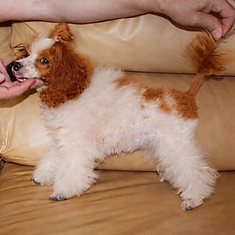
Female Solana 22sm
Female Peseta 21cm

Son of Peseta
🐩 Historical Evidence of Parti-Color Poodles
The parti-color poodle is not a recent creation.
There are artistic representations from centuries ago that clearly show poodle-type dogs with two-color patterns.
👉 In the 17th century, in works such as Rembrandt’s self-portrait (1631), a poodle with a bicolor coat can already be seen.
👉 There are even earlier references, such as a painting dated 1496 where small poodles with spots appear.
During the 18th and 19th centuries, paintings, engravings, and books frequently show two-colored poodles, indicating that this pattern was common within the breed.
This demonstrates that parti-color is not a modern trend, but a historical part of the poodle.