
The Fascinating Anatomy of a Dog
How Is a Poodle Built?
Let's imagine we're going to build a Toy Poodle from scratch.
Step 1. The Skeleton: The Foundation of Everything.
Just like any well-built structure, we first need a solid foundation. Before the fluffy coat, the muscles, and those irresistible eyes that can convince you to hand over one more treat, we need the skeleton—the sturdy framework that supports the entire body.

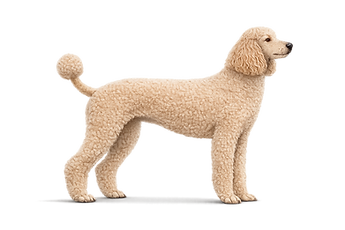
How many bones does a dog have?
An adult dog usually has between 319 and 321 bones. Why isn't there one exact number?
The answer lies in the tail. Most dogs have 20 to 23 tail vertebrae, and that small difference is what makes the total number of bones vary from one dog to another. The fewer tail vertebrae a dog naturally has, the lower its total bone count.
Humans have 206 bones. Can you imagine that those adorable three kilograms of Toy Poodle contain almost 100 more bones than you do?
So don't underestimate this little dog. Technically speaking, a Toy Poodle is built from more parts than a human.

Who Has More Bones?
The Toy Poodle doesn't hold the record,
but it's not far behind either.
Some mammals with very long tails have even more bones, while enormous whales have considerably fewer.
Surprising, isn't it?
Sometimes size can be deceiving.
Here's another fun fact: a Chihuahua, a Toy Poodle, and a Great Dane all have almost exactly the same number of bones. The difference is their size, not the number of bones. Nature used the same blueprint—it simply changed the scale.
So... do all dogs have the same number of bones? Yes... and no. If we're talking about adult dogs, then almost yes. Puppies, however, play
by their own rules. When they're born, they actually have more bones than an adult dog. Do they lose some along the way? Of course not! Many bones start out as separate pieces and gradually fuse together as the puppy grows, forming stronger and more durable bones.
So technically, a puppy comes with "more parts in the box." Over time, nature takes care of the final assembly. 😄
Step 2. Muscles: Installing the Engine.
The framework is now complete. But at the moment, our Toy Poodle is only very good at pretending to be a museum exhibit. To run, jump, wag its tail, and mysteriously disappear with one of your socks, it needs muscles.
Muscles are attached to the bones by tendons, allowing the entire skeleton to move.
Some muscles work only when the dog chooses to use them—those in the legs, neck, or tail, for example. Others never wait for permission, such as the heart muscle, the muscles used for breathing, and the muscles that form the walls of the internal organs.


The muscles of the hind legs are especially powerful because they provide the force needed for running and jumping. Even when a Toy Poodle is standing perfectly still, its muscles are constantly working to maintain its posture.
And what about when it shivers? That's the muscles too. These rapid, involuntary contractions help the body produce heat.
A three-kilogram Toy Poodle can have more than one kilogram of muscle tissue. In other words, a large part of this small, cheerful dog is actually a powerful engine. Just one with curls... and a mind of its own.
The skeleton gave our Toy Poodle its shape. The muscles gave it movement. Now it can run—next, we'll discover how its bones bend without breaking and why nothing squeaks.
Builder's Fun Facts.
1. A dog uses about 18 muscles to move its ears. Humans have only about 6, and most of us can't even use them. So the next time your Toy Poodle swivels one ear the moment it hears a treat bag being opened... you'll know why it wins that competition every time.
2. Dogs have facial muscles that allow them to raise their eyebrows and create the famous: "You're really not going to give me a treat?" look.
Scientists have discovered that dogs evolved a small muscle around the eyes that wolves barely use. It seems that thousands of years of living alongside humans turned that irresistible expression into a remarkably successful strategy.
3. Thanks to its muscles, a Toy Poodle can jump several times its own height. Not bad for someone who weighs less than a bag of potato chips.
4. When a dog shivers from the cold, its muscles perform hundreds of tiny contractions every minute to generate heat. It's the very same emergency heating system our own bodies use.
Step 3. Joints: Installing the Hinges.
Our Toy Poodle now has a sturdy skeleton and a powerful engine. But there's still one problem: bones are rigid. If they were connected like pieces glued together, our little construction project could do little more than stand still.
Fortunately, nature came up with a much better idea: joints. They are the "hinges" of the body, allowing every movement to be smooth, precise, and flexible. Think of a door. Without hinges, it couldn't open. Bones work exactly the same way: joints allow the legs to bend, the neck to turn, the jaw to move, and even the tail to wag with excitement.
Articular Cartilage.
But there's another clever detail. The ends of the bones never touch each other directly. Instead, they're covered with a layer of articular cartilage—a smooth, durable tissue that acts as a natural shock absorber. Thanks to it, the bones can move thousands of times a day without wearing out.
Synovial Fluid.
As if that weren't enough, every joint produces a special fluid called synovial fluid. It works much like the oil in a car engine, reducing friction and helping everything move smoothly.
How Hard Does a Joint Work?
A Toy Poodle can take tens of thousands of steps every day. That means its joints are working constantly—from the moment it wakes up until it decides it's time for a nap... usually on the sofa.
Did You Know?
Joints don't just make movement possible. They also help absorb the impact every time a dog runs or jumps. Without them, every landing would be like hitting the ground with two wooden sticks.

Diagram of a Joint
1.Joint 2.Synovial Fluid
3. Articular Cartilage
Step 4: Ligaments and Tendons: The Connections That Bring Movement to Life.
Our Toy Poodle now has a strong skeleton, joints that allow movement, and muscles capable of generating force. However, one essential part of the mechanism is still missing. Imagine a car with a powerful engine but no drive belts, or a crane without steel cables: all the power would be there, yet it would be unable to move anything at all.
This is where ligaments and tendons come into play—two structures that are often confused, even though they perform very different functions.
Ligaments connect one bone to another. They reinforce the joints, keep the bones in their proper position, and limit excessive movements that could lead to injury. Thanks to them, each joint remains stable even when the dog is running, jumping, or changing direction at high speed.

Tendons, on the other hand, connect muscles to bones. When a muscle contracts, the tendon transfers that force to the corresponding bone, producing movement. Without tendons, even the strongest muscles would be unable to move the body.
We can think of the muscles as the engine, the tendons as the cables that transmit the force, and the ligaments as the safety systems that keep the entire structure stable and under control.
Although both ligaments and tendons are extremely strong tissues, they receive a much lower blood supply than muscles. As a result, when they are injured, they usually heal more slowly and require time, rest, and appropriate rehabilitation.
Did You Know? Tendons are among the strongest tissues in the body. Relative to their size, they can withstand forces equal to several times a dog's body weight during running or jumping.
Now the mechanical part of our construction is complete. The skeleton supports the body, the joints allow movement, the muscles generate force, the tendons transmit that force, and the ligaments keep every part securely in place.
But our Toy Poodle is not alive yet. We still need to install the heart, the lungs, and all the other organs that will bring this extraordinary organism to life.
Our Toy Poodle can now run, jump, and turn with ease. But it's still missing something essential: a system capable of delivering oxygen and nutrients to every muscle in its body. It's time to start the heart.
Step 5. The Heart: Starting the Pump.
Our Toy Poodle now has a strong skeleton, powerful muscles, and joints that let it move with ease. But there's still one problem: not a single cell can function without oxygen and nutrients. It's time to start the most important engine of all—the heart.
The heart is a muscular pump that works 24 hours a day, without stopping.
How Does the Heart Work?
Imagine your Toy Poodle's body as a large city. Every cell is a little house that needs food and oxygen every single day. The heart is the delivery service that never arrives late. With every heartbeat, it sends blood throughout the body, delivering the "supplies" and collecting the waste that's no longer needed. Then it repeats the journey again and again—thousands of times a day, without taking a single minute off.
If the heart ever asked for a vacation, the rest of the body would go on strike immediately.
In a healthy adult Toy Poodle, the heart beats about 100 to 140 times per minute while resting. During play or a run, that rate can increase considerably to deliver more oxygen to the muscles.
How Big Is It?
Despite working nonstop for an entire lifetime, a Toy Poodle's heart weighs only a few dozen grams. It fits comfortably in the palm of your hand... yet it keeps the entire body running.

With every heartbeat, the heart pumps blood through thousands of kilometers of blood vessels, delivering oxygen and nutrients to every corner of the body while collecting waste products so they can be removed.
Did You Know? Small dogs have faster-beating hearts than large dogs. A Great Dane can have a much slower pulse than a tiny Toy Poodle. It's the same rule seen in many mammals: the smaller the body, the faster the heart needs to work.
That means that while you're reading this paragraph, your Toy Poodle's heart has already beaten several more times than yours. And it will keep doing so without your dog having to think about it for even a single second.

Step 6. Blood and Blood Vessels: Building the Road Network.
The heart is now working. But… how does blood reach the very tip of the nose, the ears, or even the last claw on a paw? The answer is simple: it needs an enormous network of roads.
Blood vessels are like highways, roads, and small paths that reach every corner of the body. Through them, blood travels, carrying oxygen, nutrients, and everything the body's cells need to continue functioning.
Arteries are the outbound highways, carrying blood from the heart to the rest of the body. Veins are the return roads, bringing blood back to the heart so the journey can begin again. Between them are the tiny capillaries, so narrow that red blood cells have to pass through almost single file.
Blood isn't just a red liquid—it's a complete delivery team.
🔴 Red blood cells: They carry oxygen.
⚪ White blood cells: They're the security guards, searching for viruses and bacteria.
🟡 Platelets: They're the emergency repair crew. If there's a wound, they rush in to help seal the leak.
Why Does the Veterinarian So Often Order a Blood Test?
Because blood travels throughout the entire body. If something unusual begins to happen in an organ, the blood is often the first to "find out." It can reveal signs of infection, inflammation, anemia, liver, kidney or pancreatic disease, and even hormonal disorders.
Imagine that every organ writes a short message about how it's doing. The liver says, "Everything's fine." The kidneys reply, "Nothing to report." But if one of them starts having problems, that information travels in the blood as well. That's why a simple blood test can often detect trouble long before obvious symptoms appear.
That said, a blood test doesn't tell the whole story. Some diseases cause little or no change in the blood during their early stages. That's why veterinarians always interpret blood test results together with the physical examination, the symptoms, and, when necessary, additional tests.
Step 7. The Lungs: Filling the Oxygen Tank.
Our Toy Poodle now has a heart working like a pump and a network of blood vessels reaching every part of its body. But it's still missing one essential ingredient: fuel. The muscles, the brain, and every organ need oxygen to function. That's where the lungs come in—they're the body's exchange station.
Every time your Toy Poodle breathes in, air enters through the nose, travels down the trachea, and reaches the lungs. There, something remarkable happens: oxygen passes into the bloodstream while the blood releases carbon dioxide, which leaves the body with the next breath.
Millions of Tiny Air Sacs.
The lungs are made up of millions of tiny alveoli—microscopic air sacs with walls so thin that gas exchange takes place in just a fraction of a second. If they could all be spread out, they would cover a surprisingly large surface area for such a small dog.
Our delivery team now has its fuel. The red blood cells collect oxygen in the lungs and set off on their journey throughout the body. Every muscle, every organ, and every single cell receives exactly what it needs to keep working.

Why Do Dogs Pant?
Unlike people, dogs hardly sweat through their skin. When they get hot or exercise, they pant. By moving air rapidly over their tongue and through their airways, they release excess heat and help cool their bodies. It's their own natural air-conditioning system.
Fun Fact.
A Toy Poodle can breathe much faster than a person. While we usually take 12 to 20 breaths per minute at rest, a small dog typically breathes 15 to 30 times per minute. After an energetic play session... that's a different story.
We now have a strong body, a heart that never stops pumping, blood delivering oxygen, and lungs constantly filling that invisible fuel tank. But we're still missing the real foreman of this construction project: the brain, the organ that coordinates absolutely everything.
Step 8. The Digestive System: Installing the Kitchen.
Our Toy Poodle now has muscles, blood, and oxygen. But all that machinery needs energy. It's time to install the body's kitchen, storage room, and recycling center: the digestive system.
A Kibble's Journey.
It all begins in the mouth. The teeth crush the food while saliva moistens it and begins the digestive process. Besides helping food slide smoothly into the stomach, saliva also contains substances that help protect the mouth against certain microorganisms.
Next, the food travels down the esophagus to the stomach, where it mixes with gastric juices and is broken down into smaller and smaller pieces.
Its next destination is the small intestine—the body's true nutrient specialist. Here, proteins, fats, carbohydrates, vitamins, and minerals are absorbed into the bloodstream to nourish the entire body.

Further along, the large intestine recovers much of the remaining water and prepares the waste that the body no longer needs. The useful materials stay... and everything else is politely shown the exit. The intestines are the body's true warehouse manager, deciding which nutrients enter the bloodstream and which materials are no longer worth keeping.
Did You Know?
For many years, people believed that a dog's saliva had remarkable healing powers. Today we know that's not entirely true. Saliva does contain substances with antibacterial properties and can help clean small wounds when a dog licks them, but it can also carry bacteria. So while licking a wound is completely natural behavior, it doesn't always speed up healing and, in some cases, may even delay it.
Step 9. The Urinary System: Installing the Cleaning System.
Our Toy Poodle has now turned food into energy. But, just like in any factory, every job leaves behind waste. To keep the body clean and balanced, it needs an efficient cleaning system. That's the job of the urinary system.
The Kidneys: The Body's Filters. The kidneys work like two high-precision filters. All day long, they clean the blood, remove waste products, and regulate how much water and minerals the body needs to keep.
What Happens to Everything That's Left Over? The waste products removed from the blood by the kidneys mix with water to form urine. From there, it travels through two thin tubes called the ureters to the bladder, where it is stored until it's time to leave the body.
A Factory That Never Takes a Break.
Even when your Toy Poodle is fast asleep, its kidneys never stop working. They filter the blood thousands of times a day, keeping the entire body running smoothly.

Did You Know? When a dog sniffs another dog's urine, it isn't just smelling "pee." It's actually reading a message packed with information: who passed by, whether it was a male or a female, roughly how old the dog was, and even whether it was ready to reproduce. To a dog, a tree can become a real community bulletin board.
One More Fun Fact... Many dogs can hold their urine for several hours, but that doesn't mean it's healthy to do so regularly. Just like us, they need to empty their bladder on a regular basis to keep their urinary system healthy.
Step 10. The Reproductive System: Ensuring the Future of the Breed.
Our construction is now almost complete. The organism can move, breathe, eat, and respond to the world around it. However, one system is still missing—its purpose is not to keep a single individual alive, but to ensure the continuation of the entire species.
This is the reproductive system.
In males, this system consists primarily of the testes, epididymides, vas deferens, prostate gland, and penis. Its main function is to produce sperm cells and the male sex hormones, particularly testosterone, which also plays an important role in muscle development, metabolism, and behavior.
In females, the reproductive system includes the ovaries, uterine tubes (fallopian tubes), uterus, cervix, and vagina. The ovaries produce the ova (egg cells) and female sex hormones, while the uterus provides the ideal environment for the development of the puppies during pregnancy.
In addition to enabling reproduction, this system is involved in many other functions of the body. Sex hormones influence growth, maturation, metabolism, physical development, and even certain aspects of behavior.
For Toy Poodles intended for responsible breeding, a healthy reproductive system is essential for preserving the health of the breed and passing on the best physical and genetic traits to future generations. For this reason, veterinary examinations and health testing play a vital role before any breeding is planned.
With this system now in place, our construction is almost complete. Only one final step remains: connecting the control center that coordinates every function of the body—the brain and the nervous system.

Fun Fact.
Full speed ahead! Some nerve impulses travel at more than 100 km/h (62 mph). That's faster than many cars driving through city streets. The nervous system works so quickly that it can seem as if the dog already knows what's about to happen. But it's not magic—it's simply an extraordinarily fast messaging system.
Toy Poodles are among the smartest dog breeds in the world. They learn new commands remarkably quickly and, with positive training, can remember dozens or even hundreds of words and gestures.
The brain doesn't just control movement. It also stores memories, recognizes people, learns routines, and knows exactly when you usually open the refrigerator.
We now have a Toy Poodle that can think, learn, and make decisions. But it's still missing its sensors: eyes to see, ears to hear, and a nose capable of finding a hidden treat on the other side of the room.
The Nerves: The Body's Wiring.
If the brain is the computer, then the nerves are the cables. They carry messages from the brain to the muscles and send information back from the eyes, ears, nose, and skin. Thanks to them, the body always knows what's happening.
Imagine your Toy Poodle accidentally steps onto a very hot surface. In a fraction of a second, the nerves send a signal to the brain, which immediately responds: "Lift your paw!" It all happens so fast that it seems completely automatic.

Step 11. The Brain and Nervous System: Installing the Control Center.
Our Toy Poodle is now fully assembled. It has a strong skeleton, powerful muscles, a heart that pumps blood, and lungs that supply oxygen. But there is still one small problem: all those parts need to work together. And for that, they need a boss. That boss is the brain.
An Incredible Computer. The brain receives information from all over the body, makes decisions, and sends out commands in a fraction of a second. Everything happens so quickly that your Toy Poodle can react before you have even finished throwing a ball.
Who Does What? The nervous system has two main working teams.
The central nervous system—the brain and spinal cord—is the boss. It thinks, analyzes information, and makes decisions.
The peripheral nervous system is made up of the messengers. Thousands of nerves run throughout the body, carrying messages back and forth. Imagine a large company. The brain is the director. The spinal cord is the head office. And the nerves are thousands of couriers racing through the body delivering messages. If one of those couriers loses its way... part of the body will stop receiving instructions.
Step 12. The Senses: Installing the Sensors.
Our Toy Poodle can now breathe, run, and jump. But it still needs to discover the world around it. To find its way, locate food, recognize its family, or detect danger, it relies on three amazing sensors: its nose, eyes, and ears. They gather information from the environment and send it to the brain, which decides what to do next.
The Nose: A Dog's Superpower.
While humans experience the world mainly through sight,
dogs explore it through their noses. We have around 5 to 6 million scent receptors, while a dog can have 220 to 300 million.
A dog's nose never takes a break. Even during a leisurely walk,
it constantly analyzes the air and the ground, detecting scents
that simply don't exist from our point of view.

Did You Know?
A dog's nose print is just as unique as a person's fingerprint. No two dogs have exactly the same nose. In fact, some countries have used nose prints to identify dogs, much like fingerprints are used to identify people. Every nose has its own unique pattern. In other words, your Toy Poodle carries its own personal "ID card" right on the tip of its nose.
Did You Know? Some dogs can develop an unusual condition known as snow nose. During the winter, or when they receive less sunlight, their nose may lighten in color, changing from deep black to brown or even pink. When sunnier days return, the nose often regains its original color.
Veterinarians are still studying exactly why this happens, but it is believed to be related to temporary changes in the production of melanin, the pigment responsible for the nose's color.

😄 So if your Toy Poodle suddenly sports a lighter-colored nose one winter, it doesn't mean it forgot to put on sunscreen... it's probably just showing off a genuine snow nose.
The Ears: A Radar That's Always On.
A Toy Poodle's hearing is just as impressive. It can hear much higher-pitched sounds than we can and detect noises that would pass completely unnoticed by the human ear.
Each ear is controlled by around 18 muscles, allowing it to swivel and pinpoint exactly where a sound is coming from. Humans still have a few ear muscles too... but most of us can't even move them.
By the time you're still wondering where that noise came from, your Toy Poodle has already located it... and has probably decided whether it's worth going to investigate.
The Eyes: A Different World.
Although dogs and humans look at the same scenery, they don't see it in exactly the same way.
Toy Poodles can distinguish fewer colors than we can. While humans see a wide range of colors, dogs mainly perceive shades of blue and yellow. Reds and greens look much more similar to them.
If you throw a red ball onto bright green grass, you'll spot it right away.
Your Toy Poodle will probably find it with its nose before it finds it with its eyes.
This is how a person sees the world

This is how a dog sees it

Where dogs really outperform us, however, is in detecting movement. Their eyes are designed to spot anything that moves,
even from quite a distance.
They also see much better in low light. Behind the retina is a special layer called the tapetum lucidum, which acts like a mirror and makes the most of the available light. Thanks to it, dogs can move around with ease at dawn, at dusk, and even during the night.
So by the time you're saying, "I can't see a thing!", your Toy Poodle is still walking along as if it were broad daylight.
Dogs don't need to see every color to understand the world. While we rely mostly on our eyesight,
they combine what they see with an extraordinary sense of smell and highly sensitive hearing. It's like solving the very same puzzle... just with a completely different set of pieces.
Did You Know? A dog's eyes seem to glow at night when light shines on them.
It's not magic, and they're certainly not hiding tiny flashlights. The glow comes from the tapetum lucidum, the reflective layer behind the retina that improves vision in low-light conditions.
Three Senses, One Goal.
Each of these senses has its own job. The nose finds, the ears listen, and the eyes watch. The brain then combines all that information in a fraction of a second to decide what to do next. Thanks to this remarkable teamwork, your Toy Poodle can explore the world, learn, play, and—of course—find a hidden treat long before you even remember where you left it.

Step 13. The Skin: The Body’s Final Protective Layer.
Our Toy Poodle can now move, breathe, pump blood, digest food, coordinate every movement, and perceive the world through sight, hearing, smell, taste, and touch. All the essential components of the body are now in place.
However, our construction is still not completely finished. All of these systems need a protective layer that shields them from the outside world while allowing them to function properly.
Now it is time to add the body's final layer: the skin.
The skin is the largest organ of the body. It protects the internal tissues from impacts, microorganisms, and harmful substances, helps regulate body temperature, and prevents excessive water loss. It also contains thousands of nerve endings that allow the dog to sense touch, pressure, pain, and temperature.
Did You Know? The skin is the largest organ in a dog's body. Depending on the dog's age, body condition, and the amount of subcutaneous tissue, it accounts for approximately 12–24% of total body weight.
Interesting Fact. Unlike humans, dogs do not sweat over most of their skin.
Their functional sweat glands are located primarily in the paw pads, so they release excess body heat mainly by panting.
The skin also contains blood vessels, sebaceous glands, and hair follicles—the tiny structures from which each hair grows.
Thanks to this complex organization, the skin not only protects the body but also forms the foundation for one of the Toy Poodle's most distinctive features: its extraordinary coat.
Step 14. The Coat: The Finishing Touch to Our Construction.
Our construction is now almost complete. The skeleton supports the body, the joints allow movement, the muscles generate force, the heart pumps blood, the lungs supply oxygen, the brain coordinates every action, and the skin protects the entire organism. Only one final piece remains—the feature that makes the Toy Poodle instantly recognizable anywhere in the world.
Now it is time to add its extraordinary coat.
Unlike many other dog breeds, the Toy Poodle's hair grows continuously and remains in the growth phase for much longer. As a result, seasonal shedding is usually much less noticeable. Hairs that have completed their growth cycle do not always fall to the ground. Instead, they often become trapped within the curls and mix with the new hair that continues to grow.
And now… our construction is complete.
What began as a box filled with separate parts has become a living organism, where every structure depends on the others. No bone could support the body without muscles, no muscle could function without tendons, the heart would be meaningless without the lungs, the brain could not interpret the world without the sense organs, and the Toy Poodle's distinctive coat could not exist without the healthy skin that serves as its foundation.
This is the anatomy of the Toy Poodle: an extraordinary collection of systems working in perfect harmony to bring to life one of the world's most elegant, intelligent, and admired dog breeds.
For this reason, the Toy Poodle requires regular brushing. If dead hair is not removed, it begins to tangle, forming knots. Over time, these can develop into dense mats that pull on the skin, reduce air circulation, trap moisture, and increase the risk of skin irritation or infections.
The coat also serves as a protective layer. It helps insulate the body from both cold and heat, protects the skin from minor impacts and ultraviolet radiation, and reduces direct contact with dust and other particles in the environment. Keeping the coat in good condition depends directly on healthy skin, a balanced diet, and proper grooming.
The Toy Poodle's different coat colors are the result of the distribution of pigments produced in the hair follicles. However, coat color can change over time due to age, genetics, or the influence of certain hormonal and environmental factors. As a result, the appearance of the coat continues to evolve throughout the dog's life.

Final Step. The Soul of a Toy Poodle.
We've finally built our Toy Poodle, piece by piece.
We've given it a skeleton to support its body, muscles to run, a heart to pump blood, lungs to breathe, a digestive system to provide energy, kidneys to keep its body clean, a brain to think, and senses to discover the world. It sounds as though everything is complete... doesn't it? Not quite.
There's one thing you won't find in any anatomy book. It can't be seen on an X-ray, and no microscope will ever reveal it. It's what makes a Toy Poodle more than just a dog—it makes it a lifelong companion.
It's the joy with which it greets you when you come home, the curiosity with which it explores the world, the intelligence that helps it learn new things, and the affection it gives without expecting anything in return. Every Toy Poodle has the same number of bones, the same muscles, and the same organs. Yet no two have exactly the same personality. That's where the real magic lies.
Science can explain how its body works. But love, loyalty, and that special sparkle in its eyes... belong to a different part of the story. And perhaps that's why, when we hug our Toy Poodle, we never think about its 320 bones, its heart, or its lungs. We simply hug another member of the family.

To create this guide, we consulted veterinary anatomy textbooks, scientific publications, and well-known references such as Miller's Anatomy of the Dog and Textbook of Veterinary Anatomy. The rest is our own contribution: we decided to replace the traditional textbook style with a much more enjoyable way of learning. So instead of memorizing page after page, we'll build a Toy Poodle piece by piece… hopefully keeping you awake all the way to the very last hair.