

First course: puppy basics
The puppy is home. Now what?
Now everything depends not on the puppy, but on you. In a few months, you’ll either be walking proudly with a well-behaved dog… or thinking: “What have I got myself into?” Let’s make sure the first option comes true. Start with the first topic and follow the course step by step.
How to prepare your home for a puppy’s arrival?
Everything starts long before your puppy walks through your front door.
It starts the day you think: “I want a dog.”
When you’re expecting a baby, you prepare the room, buy what you need, and make the house safer. Well, with a puppy it’s exactly the same. He is also a little furry baby who needs a prepared environment to start his new life on the right paw.
Let’s see how to do it.
What should you buy for your puppy... and what can you skip?
So you don't waste money on things you'll never use, we've put together a guide to everything sold for dogs: what your puppy really needs, what can wait, and what you can safely do without.
Click on the image before you go shopping. Your puppy will thank you...
...and so will your wallet.

When is the best time to bring a puppy home?
There is an age when a puppy still needs its mother more than it needs you. At just six weeks old, it is still learning things from her that no person can teach. A few weeks later, the mother begins to grow tired of her puppies, and the time comes for each of them to start their own journey.
So... when is the ideal age for a puppy to move to its new home? Let's find out.
What documents will you receive with your puppy?
By the time your puppy comes home with you, it has already met the veterinarian.
It has already been dewormed, received its first vaccinations, and all of this should be recorded in its health documents. This information is essential so that your own veterinarian knows which treatments your puppy has already received and how to continue its vaccination and healthcare schedule correctly.
What vaccinations may your puppy have received before coming home?
There is no single vaccination schedule. Every veterinarian may follow a slightly different protocol depending on the puppy's age, size, and overall health. That's why it's important to understand your puppy's vaccination record and know which vaccines have already been given. For very small puppies, the vaccination schedule may begin a little later. And if the first vaccine was not well tolerated, the next one may be postponed for a few days until the puppy has fully recovered. In this video, we'll explain how to read and understand your puppy's vaccination schedule.
If you’d like to better understand how vaccination works in puppies and adult dogs, we also have a complete guide where we explain everything in more detail.

While you're here, we've also prepared a guide explaining which parasites can make your dog's life miserable, how to get rid of them, and, most importantly, how to stop them from coming back.
How will you bring your puppy home?
Take a moment to think about it. This will be your puppy's first journey... and probably the most important one of its life. Everything will be new: the smells, the sounds, the car, and the people around it. You certainly don't want your puppy to remember that day as its first frightening experience.
In this video, we'll show you how to make your puppy's journey home calm, safe, and as comfortable as possible.
How to behave with a newly arrived puppy.
Bringing a puppy home is an exciting moment, but also a very important stage in its development. From day one, your behavior will shape how the puppy understands its new home. What to do from the very beginning:
1. Stay calm. Avoid shouting, excessive excitement, and intense stimulation. The puppy needs calm, not overload.
2. Give it a clear space. From the start, it should understand where to sleep, where to rest, and where it can stay, this helps reduce anxiety.
3. Don’t overwhelm it with attention. It’s natural to want to touch it all the time, but: it needs to observe, and adapt at its own pace.
4. Start setting gentle rules. No punishment, but consistency: if something is not allowed → it’s never allowed.
If something is allowed → it should always be the same clarity from day one.
Where should your puppy's bed be?
On the first night in its new home, your puppy will have suddenly lost everything it has ever known: its mother, its littermates, and the place where it was born. Now, you are its new family.
That's why it's not a good idea to put your puppy's bed in an empty room or in the kitchen, where no one is at night. To a puppy, that doesn't mean having "its own room"—it means the pack has gone to sleep... without it.
The best place for your puppy's bed is close to where the family sleeps. Hearing your breathing and knowing it isn't alone will help your puppy feel much calmer and settle into its new home more quickly. This is especially important for the Toy Poodle, a breed that forms a very strong bond with its people and needs to feel close to its family.
As your puppy grows up, it will still see itself as part of your "pack." That's why it's worth choosing a place from the very beginning where it feels safe and that can remain its special spot for many years to come.
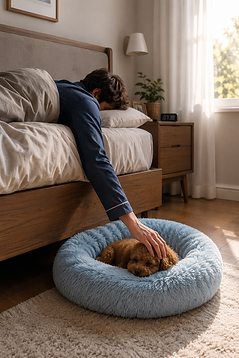
The First Night.
For you, it will be the first night with your puppy. For your puppy, it will be the first night without its mother.
Until yesterday, it slept curled up next to its mother and littermates. It felt their warmth, heard their breathing, and every time it woke up, its family was still there. Today, everything has changed. A new home, unfamiliar smells, and people it has only just met. If your puppy wakes up during the night and finds itself alone, it won't understand what has happened. It doesn't know that you love it, that you haven't abandoned it, or that you'll be there again in the morning. It only knows one thing: its family is gone.
So if your puppy cries during that first night, it isn't trying to manipulate you or being spoiled. It's simply calling for its family.
Don't be afraid of "spoiling" your puppy on that first night. It's impossible to spoil a baby that lost its entire family just a few hours ago.
A Name Is Not a Passport.
It's the first command your puppy will ever learn. It's the signal that means: "They're talking to me now." That's why your puppy's name should be short, easy to say, and clearly different from any command. For example, if you name your puppy Nomen, the command "No!" will probably stop being clear to your dog.
And one more important rule. If your dog's name is Sara, then she is always Sara. Not "my little princess" today, "my little rascal" tomorrow, and "my fluffy baby" the day after. You can use as many affectionate nicknames as you like, but whenever you want your dog to pay attention, always use its real name. That way, your puppy will quickly learn that this sound means: "They're talking to me."

How to teach a puppy to use a pee pad.
During the first weeks after arriving home, puppies cannot go outside. That’s why it
is essential to properly teach them how to use a pee pad.
Starting point.
Our puppies usually already know what a pee pad is and what it is for. However,
after moving to a new home, they still need to relearn where to go.

How to teach it step by step.
1. Place several pee pads. At the beginning, put 2 or 3 pee pads in different areas of the house, and the puppy will choose the place that feels most comfortable.
2. Watch for the key moments. A puppy usually needs to relieve itself: after sleeping, after eating, and after playing, at those times, take it to the pee pad.
3. Reinforce immediately. When it does it correctly: “good job!”
4. Avoid punishment. If the puppy makes a mistake: don’t shout, don’t punish, simply clean it up and keep going.
⚠️ Common mistakes: using only one pee pad, moving it around constantly, not supervising the puppy, and punishing mistakes.
Key advice: consistency is more important than speed.
Kennel tip (very important). To help the puppy choose the pee pad: clean the entire floor with a scented cleaning product,
without chlorine or ammonia, and leave the pee pad unscented. The puppy will perceive the floor as an “unpleasant area”
and the pee pad as the only neutral place. This makes learning much easier.
Water.
Your puppy should have water available at all times. Not “at certain hours”, not “after meals”, and not “so he won’t pee at night”. Always.
It’s best to place the water bowl in one fixed spot so your puppy always knows where to drink. If your home is large, you can place two bowls in different rooms during the first few days.
Don’t worry if your puppy drinks more or less than usual at first. Moving house, stress, new food, or warm weather can temporarily change his habits.
And most importantly: never take water away at night hoping he won’t need to pee. Depriving a puppy of water is far worse than getting up one more time to take him to the puppy pad.
Did You Know How a Dog Drinks?
Unlike humans, dogs do not suck water in with their lips. Instead, they dip their tongue into the water at incredible speed and curl the tip backward, forming a small ladle. With this motion, they lift a column of water upward and close their mouth before the water falls back. A dog can repeat this movement several times per second. That's why it's perfectly normal to find water splashes around the bowl. It's not because your dog is a messy drinker—it's simply the way a dog's drinking mechanism works.
An adult dog needs, on average, 50–60 ml of water per kilogram of body weight each day. This means that a Toy Poodle weighing around 3 kg (6.6 lb) will usually drink about 150–180 ml (5–6 fl oz) of water per day. On hot days, after exercise, or when eating dry kibble, the daily water intake may be considerably higher.
If you suspect that your dog is drinking either too little or too much, we recommend reading our guide, "How to Tell if Your Dog Is in Pain." There, we explain when a change in water consumption is perfectly normal and when it could be an early sign that your dog needs to see a veterinarian.


When to start training a Toy Poodle?
Training a Toy Poodle begins much earlier than most people think. There is no need to wait for the puppy to grow up to start. In fact, the first weeks are key to its development.
From the moment the puppy arrives home, it is already learning: it observes, reacts, adapts, and begins to understand how its new environment works.
That is why training does not start with commands, but with habits.
At what age can you start?
You can start from a very early age, as soon as the puppy has settled into its new home. At this stage, the goal is not perfection, but to:
create routines, set boundaries, reinforce correct behaviors, teach calmness, begin building a bond.
Training sessions should be short, positive, and adapted to the puppy’s age. With a Toy Poodle, just a few well-done minutes are far more effective than a long session. When it comes to training a Toy Poodle, it’s not about when you start, but how you do it from day one.
Common mistakes when starting out.
One of the most common mistakes is trying to teach too many things at once. Another frequent error is waiting too long and leaving training “for later.” In a breed as intelligent as the Poodle, the earlier learning begins, the better. It is also important not to shout, not to punish out of confusion, and not to use different words for the same command. The key is consistency and clarity.
What to teach a Toy Poodle puppy first.
Before thinking about tricks, it is important to focus on the basics: recognizing its name, coming when called, understanding the word “no”, not biting hands or clothes, learning to relax, following simple routines.
These foundations are the basis for all future training.
How to teach it step by step.
1. Start close. Don’t throw the ball far at first.
2. Throw it a short distance. Just a few meters.
3. Encourage the dog. “come on!” “bring it!”
4. Receive it correctly. When the dog comes back: don’t grab the ball suddenly. teach it to let go.
5. Trade. Use a reward so the dog releases it: ball → treat.
6. Mark and reward. “good job!” reward.
7. Repeat several times. To build the full habit. Add the command. Once the dog is doing it well: “bring it” / “fetch”.
Recommended cue: Word: “fetch” Gesture: hand motion calling the dog toward you. How long to practice: Keep sessions short,
make it a lively game, and stop before the dog gets tired.
⚠️ Common mistakes: Throwing the ball too far at the beginning → the dog doesn’t come back. Chasing the dog → turns the game into running away. Not teaching “release” → the dog keeps the ball. Repeating too much → the dog loses interest.
Key tip: The trick is not running… it’s coming back to you.

Fetch.
This exercise teaches the dog to retrieve an object and bring it back to its owner.
It is one of the most useful and fun games, and it also helps burn energy.
Goal. For the dog to: go after the ball, pick it up, bring it back
and release it.